
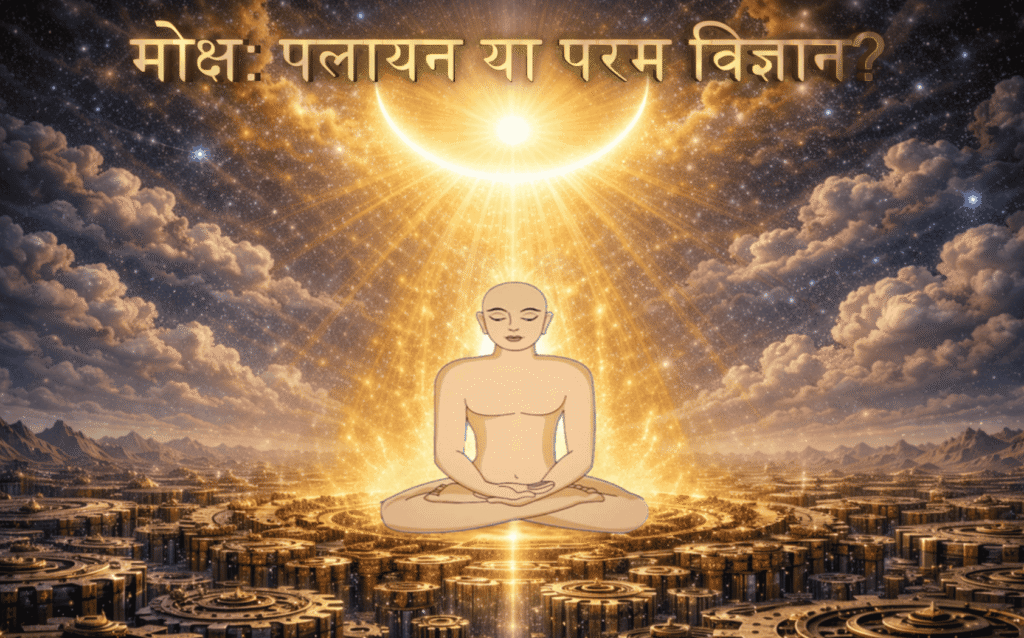
Recently, in some intellectual discussions and articles, an argument has surfaced: "The desire to be free from the cycle of birth and death (Moksha) out of fear of life's sorrows is a form of escapism." At first glance, this argument may seem modern and 'practical'. To a world racing in the pursuit of materialism, it often appears that pausing or talking about liberation is synonymous with turning one's back on life's challenges. However, when we delve into the scientific depth of Jain Philosophy, this conclusion is revealed to be extremely superficial and misleading.
Let us logically analyze this misconception and understand why the modern world is still centuries behind in comprehending this science.
Moksha and Escapism: Myth and Reality
1. Moksha is not an 'Escape', but the 'Ultimate Effort' (Param Purusharth) Escapism implies running away from responsibilities out of fear or cowardice. However, in Jain philosophy, the path to attaining Moksha is not for cowards, but for the 'brave' (Veer). An escapist runs from external circumstances, whereas an aspirant of Moksha fights their internal weaknesses (anger, ego, deceit, greed). Defeating others is easy, but conquering one's own senses and passions is the greatest 'effort' (Purusharth). That is why one who walks this path is called 'Mahavira' or 'Jina' (The Victor).
2. Moksha is not a fabricated system of 'religious contractors' The belief that past lives and Moksha are mere 'assumptions' is born of ignorance. In Jainism, Moksha is not an imposed idea; it is the real and pure state (Vastavik Swabhaav) of the soul. Just as the fundamental nature of water is 'coolness', the fundamental nature of the soul is 'infinite knowledge and infinite bliss'. The return of the soul to its original, pure nature upon the removal of karmic impurities is Moksha. It is not blind faith, but a state recognized through 'self-realization' (Aatmanubhav).
3. Moksha is not a 'Resort' (Destination), but a 'State of Being' To think that "Moksha is a geographical place to go and sit" is entirely incorrect. Practically, it is the fully independent and detached (Veetraga) state of the soul. According to Jain Cosmology (Karananuyoga), when the soul becomes free from the weight of karmas, due to its 'upward nature' (Urdhvagaman Swabhaav), it ascends and rests at the highest point of the universe—the peak of the cosmos (Siddhashila). If modern physical science, whose instruments are limited to measuring only 'matter' (Pudgal), doubts the truth of this pure consciousness, then that is a limitation of the science itself. To deny this highest dimension of consciousness based on the limitations of physical instruments is illogical.
4. The journey begins not with 'Fear', but with 'Compassion' (Karuna) An escapist is selfish; they only want to remove their own sorrow. But Jain philosophy clearly states that the path to Moksha begins not with hatred or fear of the world, but with 'compassion' (Karuna). Only when selfless love for all living beings awakens in the heart of a seeker, and they embody 'complete non-violence' (Ahimsa) in their life, is the path to Moksha paved.
5. Jainism is not a 'Social Group', it is the 'Science of the Eternal Nature of Reality' If we assume that Moksha is merely an empty 'imagination', then what is the need for Jain philosophy, its pilgrimage sites, and this entire way of life? Jainism is not a 'social entity' created merely to protect its social rights or identity. It is the 'science of the eternal nature of substances' (Shashwat Vastu Swabhaav ka Vigyan). Here, the goal of every substance, especially the soul (Jiva), is to attain its fundamental nature (true bliss). The actions performed by the soul for its self-welfare dictate the true direction of this existence. To deny Moksha (the ultimate goal) means reducing the very foundation of existence to zero.
Why is modern science and the education system 500 years behind in understanding Jain philosophy?
When there is such deep scientific and psychological truth hidden in Jain philosophy, why is the modern world unable to understand it? The answer lies in the direction of human development over the past 500 years.
Material Progress vs. The Decline of Consciousness: The development of human civilization over the last 500 years has been almost entirely 'material' and 'technological'. Modern science today talks about 'Quantum Physics' and the 'Observable Universe', whereas in Jain 'Karananuyoga', units like Lok (Universe), Rajju, and Pradesha (the largest and finest units of length and space) were accurately defined thousands of years ago. Modern science has gone quite far into matter, but in the study of 'Consciousness', it is still in its infancy.
The 'Sensationalism' of Media: Today's media and cinema run on the easy formulas of 'miracles', 'controversies', and 'hero vs. villain'. Jain philosophy is not based on miracles, but on 'Veetragata' (detachment) and the 'Karma principle'. There is no God here who will descend from the sky and perform a miracle; here, every soul is the architect of its own karmas. The intellectual depth required to portray this profound 'self-accountability' on screen is something today's commercial media completely lacks.
One-Sided Perspective in Modern Education: Today's education system is technologically advanced, but ideologically one-dimensional. Power and mainstream systems always prefer to view things in 'black and white'. In contrast, Jain philosophy's 'Anekantavada' (Non-absolutism/Multi-sidedness) advocates looking at every truth from multiple perspectives. A philosophy that teaches humans to think independently does not easily fit into today's herd-mentality education system. For global crises like 'Climate Change' and 'Conflict Resolution', Jainism's non-violence (Ahimsa) and non-possessiveness (Aparigraha) are the most accurate answers, yet it has been deliberately kept away from the educational mainstream.
Conclusion
Moksha is not the name of giving up on life; rather, it is the name of attaining the highest peak of existence. Moksha is not running away from the sorrows of the world, but discovering that inherently blissful (Sukh-Swabhavi) existence hidden within, after which the impact of external joys and sorrows simply ceases.
If knowing oneself, harboring compassion for everyone, and attaining one's pure nature by becoming completely non-violent is 'escapism' in the eyes of modern thinkers... then perhaps today's restless, war-torn, and materialistically blind humanity is in desperate need of this so-called 'escapism'.
(What are your views on this topic, please share in the comments)#JainPhilosophy #Moksha #IndianKnowledgeSystem #Philosophy #SelfRealization #Ahimsa #SamavsharanKnowledge #Spirituality