
Jai Jinendra. The life of Sant Shiromani Acharya Guruvar 108 Shri Vidyasagar Ji Mahamuniraj was not merely the journey of a Jain saint, but was that spiritually rich epoch of a National Saint (Rashtra Sant), which was adorned with the triveni (confluence) of knowledge, compassion, and service. His life was the living embodiment of Lord Mahavir’s ideals, a beacon of light that inspired countless souls on the path of self-welfare (Aatma-Kalyan). This detailed article is dedicated to the life saga of that great being (Mahamanav), who wrote a new chapter in the upliftment of humanity through his renunciation and austerity.
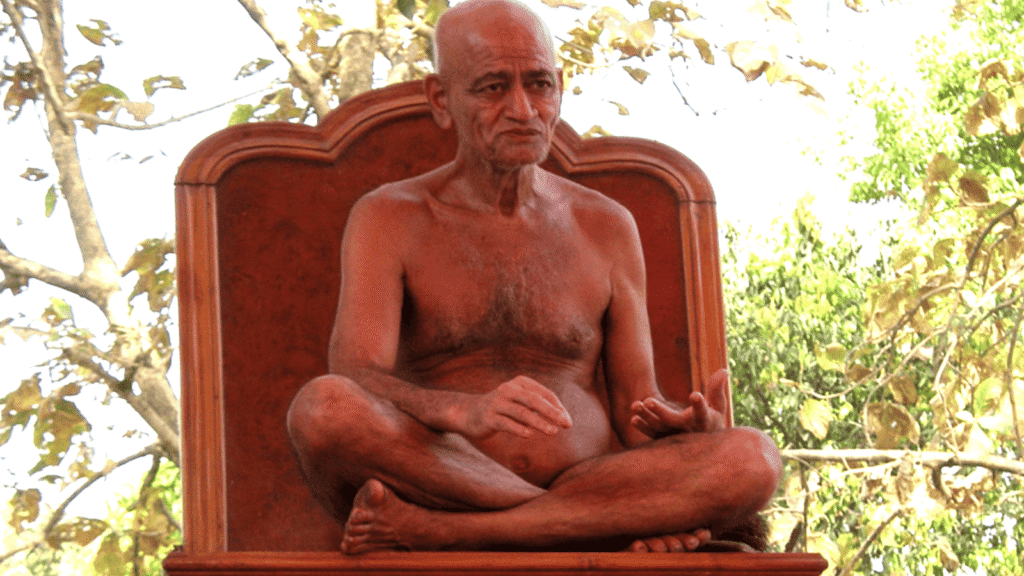
Part 1: From Vidyadhar to Vidyasagar - The Rise of a Spiritual Sun
1.1 The Advent of a Divine Childhood in Sadalga
In the village of Sadalga in the Belgaum district of Karnataka, a divine child was born at midnight on Ashwin Shukla Purnima (Sharad Purnima), Samvat 2003, corresponding to October 10, 1946, into a devout, Kannada-speaking Jain family. Born to father Shri Mallappa Ji Ashtage and mother Smt. Shrimati Ji Ashtage, the child was named Vidyadhar. He belonged to the Ashtage gotra. He was the second of four brothers; the elder was Mahavir, and the younger two were Anantnath and Shantinath, along with two sisters. From childhood, he had a deep inclination towards religion. He would often visit temples and teach the principles of dharma to his younger siblings. His nature was exceptionally simple and content; he would gracefully accept whatever was given to him. His family was affluent, blessed with wealth and prosperity. His father was an exceedingly hardworking and honest farmer, and it was from his parents that he inherited his spiritual values.
1.2 Education: Worldly and Spiritual
Vidyadhar received his primary schooling up to the ninth grade in his mother tongue, Kannada, and through the Marathi medium. However, his true thirst was for spiritual knowledge. He resolved to delve into the depths of Jain philosophy, logic, grammar, and spirituality. His multilingual talent was extraordinary; he possessed an expert level of knowledge in Kannada, Marathi, and Hindi, as well as in ancient languages like Sanskrit and Prakrit. This linguistic proficiency was not merely an academic achievement but a powerful tool for his future religious propagation (Dharma Prabhavana). It was this ability that allowed him to connect deeply with diverse communities, from his roots in Karnataka to the heartland of Hindi-speaking Bundelkhand, where he led an unprecedented religious and educational renaissance. He did not reject worldly education but transcended it, proving that true knowledge (Samyak Gyan) is not just a collection of information but a spiritual realization.
1.3 The Call of Renunciation: Initiation in Ajmer
At the tender age of 22, Vidyadhar made a firm resolve to renounce all worldly ties and walk the path of self-realization. He reached Ajmer, Rajasthan, where he dedicated his life to the most revered Acharya Gyansagar Ji Maharaj, who hailed from the glorious tradition of the great 20th-century Digambara saint Acharya Shantisagar Ji Maharaj. On the historic day of Ashadh Shukla Panchami, V.S. 2025, which was June 30, 1968, Acharya Gyansagar Ji bestowed upon him the Digambara Muni Diksha (initiation). In that moment, the existence of Vidyadhar ceased, and Muni Shri 108 Vidyasagar was born. This was the decisive turning point in his life, from where he began his profound practice of knowledge and penance at the feet of his guru.
| Event | Date | Place | Age |
| Birth | October 10, 1946 (Ashwin Shukla Purnima, S. 2003) | Sadalga, Karnataka | – |
| Muni Diksha (Initiation) | June 30, 1968 (Ashadh Shukla Panchami, S. 2025) | Ajmer, Rajsthan | 22 |
| Acharya Pad (Investiture) | November 22, 1972 (Margashirsha Krishna Dwitiya, S. 2029) | Nasirabad, Rajsthan | 26 |
| Samadhi (Passing) | February 18, 2024 (Magh Shukla Ashtami, S. 2080) | Dongargarh, Chhattisgarh | 77 |
Part 2: The Unwavering Ascetic - A Life of Supreme Austerity
2.1 The Rigorous Practice of Digambara Conduct
Acharya Vidyasagar Ji's life was his most powerful sermon (deshna). In this age of materialism and sensory pleasure, his life was a living counter-narrative. His austerity was the foundation of his spiritual authority. He traveled the entirety of India on foot (vihar) his entire life. He consumed food and water only once a day in his cupped hands (anjuli). He had renounced all items considered essential for normal life, such as salt, sugar, fruits, milk, curd, ghee, oil, and green vegetables. His diet consisted only of a limited quantity of plain lentils and roti. He slept on a wooden plank or the floor without any mattress or pillow, symbolizing the victory of the soul over the body. This extreme self-discipline was not self-mortification but a demonstration of the soul's supremacy over the body. It was this severe penance that gave his words infallible power. People trusted his guidance because he wanted nothing from this world. His detachment became a spiritual magnet, drawing millions, including the nation's top leaders, towards him.
2.2 Ascension to the 'Acharya' Position
On November 22, 1972, a unique and historic event took place in Nasirabad, Rajasthan. Acharya Vidyasagar Ji's guru, Acharya Gyansagar Ji Maharaj, before his own Sallekhana, recognizing the spiritual heights of his most worthy disciple, bestowed his own 'Acharya Pad' (position of Acharya) upon him. At that time, Acharya Vidyasagar Ji was only 26 years old. This was an extraordinary example of the guru-shishya (teacher-disciple) tradition, where the guru himself, bowing to the exceptional scholarship and penance of his disciple, declared him his successor.
Part 3: The Stream of Knowledge - Literary and Intellectual Legacy
3.1 'Mookmati' - The Epic of the Mute Soul
The pinnacle of Acharya Vidyasagar Ji's literary genius is his Hindi epic poem, 'Mookmati' (The Mute Soil). This work is not just a poem but a profound philosophical treatise. It uses the metaphor of a journey of mute clay (the karma-bound soul), which a potter (the guru) shapes on his wheel (penance) and fires in the kiln (hardships) to transform it into a sacred vessel (the liberated soul). This epic presents the complex principles of Jain metaphysics in a very simple, poetic, and accessible form. Its literary and philosophical depth is such that it has been included in the M.A. Hindi curriculum of several universities and has been translated into many languages, including English, which is a testament to its universal appeal.
3.2 A Prolific Writer and Poet
In addition to 'Mookmati', Acharyashri created a vast treasure of literature. He wrote numerous 'Shataks' (collections of 100 verses) in Sanskrit and Prakrit, among which Niranjan Shatak, Bhavana Shatak, Shraman Shatak, and Suniti Shatak are prominent. Furthermore, he also composed about 700 unpublished Haiku poems, showcasing his extraordinary command over various literary genres. His literary creation is a prime example of innovation within tradition. By using genres like the epic and haiku, he made timeless spiritual teachings relevant and engaging for a modern audience. He was not just a custodian of ancient texts but an active creator who expanded the repository of Jain literature.
Part 4: Architect of a Compassionate Society - Social and National Contributions
4.1 Pratibhasthali: A Revolution in Education
Acharyashri believed that true education builds character. With this vision, he established a series of residential schools for girls named 'Pratibhasthali'. This is not just a school but a gurukul where modern education is integrated with deep moral and spiritual values (Jain ethics). His aim was to produce knowledgeable, empowered, and virtuous citizens, which was a practical implementation of 'Samyak Gyan' (right knowledge).
4.2 Hathkargha and Dayoday: Weaving a Non-violent Economy
Acharyashri's social projects were not mere charity but integral parts of a holistic vision for a righteous society. He promoted 'Hathkargha' (handloom) to foster self-reliance, produce textiles in a non-violent manner (as opposed to machine looms), and provide people with exploitation-free livelihoods. Similarly, through the 'Dayoday Mahasangh', he established a vast network of over 100 Gaushalas (cow shelters) that care for sick, old, and abandoned cattle. This was the highest practical form of 'Ahimsa' (non-violence) and 'Jiv Daya' (compassion for living beings). All these projects together constitute a "Jain development model" that is sustainable, ethical, and compassionate, presenting a blueprint for nation-building based not on economic metrics alone, but on spiritual principles.
Part 5: The Guru's Grace - A Lineage of Renunciation
5.1 An Entire Family on the Path of Renunciation
The most extraordinary and unique aspect of Acharya Vidyasagar Ji's life was his entire family walking the path of asceticism. His spiritual aura was so powerful that his parents, Shri Mallappa Ji and Smt. Shrimati Ji, also took initiation and became Muni Mallisagar Ji and Aryika Samaymati Ji, respectively. Furthermore, all three of his brothers—Mahavir, Anantnath, and Shantinath—also took initiation from him and came to be known as Muni Utkrisht Sagar Ji, Muni Yogsagar Ji, and Muni Samaysagar Ji. Both his sisters also took a vow of lifelong celibacy. This event transcends biography and enters the realm of spiritual history. It is a testament that the spiritual path he preached was so compelling and demonstrably blissful that it dissolved the strongest worldly bonds and transformed them into a spiritual fellowship.
5.2 An Ever-Growing Sangh
Acharyashri, with his own hands, conferred more than 500 Muni, Aryika, Ailak, and Kshullak initiations, creating a vast and disciplined Sangh (monastic order). His Sangh is known for its rigorous penance, difficult spiritual practices, and strict adherence to conduct. Many of his disciples, like Muni Sudhasagar Ji and Muni Pramansagar Ji, are guiding the Jain community today. Before his Samadhi, he entrusted the responsibility of his Sangh to his sibling and senior disciple, Niryapak Shraman Muni Shri Samaysagar Ji Maharaj, which is a testament to his foresight.
Part 6: The Final Journey of a Rashtra Sant (Saint of the Nation)
6.1 A Beacon for the Nation
Acharya Vidyasagar Ji was revered not just by the Jain community but by the entire nation as a 'Rashtra Sant'. Countless leaders of the country, from the then Prime Minister Shri Atal Bihari Vajpayee to Prime Minister Shri Narendra Modi, sought his blessings from time to time. Various central ministers, chief ministers, and even foreign diplomats came to seek his guidance and were impressed by his wisdom. His special discourse in the Madhya Pradesh Legislative Assembly was a historic event. He inspired leaders to promote the Hindi language and establish Indian values.
6.2 Mahasamadhi in Chandragiri
In the final phase of his life, Acharyashri was residing at Chandragiri Teerth in Dongargarh, Chhattisgarh. When he realized that his body was no longer conducive to spiritual practice, he took the vow of 'Sallekhana', the supreme spiritual practice in Jainism. He renounced food and water, observing a complete fast for three days, and remained absorbed in constant self-contemplation. This was not a voluntary embrace of death, but a voluntary, conscious, and ultimate act of victory for spiritual purification. On February 18, 2024, at 2:35 AM in the middle of the night of Magh Shukla Ashtami, he renounced his mortal body with full consciousness and entered into Samadhi.
6.3 A Nation in Mourning, A Legacy Celebrated
The news of Acharyashri's Samadhi plunged the entire nation into mourning. Prime Minister Narendra Modi offered a deeply emotional tribute, calling it a "personal loss" and an "irreplaceable void". All major leaders of the country, including Home Minister Amit Shah, Uttar Pradesh Chief Minister Yogi Adityanath, and former Madhya Pradesh Chief Minister Shivraj Singh Chouhan, paid their respects. All major national newspapers and media channels published detailed articles on his life and work. The Chhattisgarh government declared a half-day of state mourning in his honor, an unprecedented tribute for a Digambara saint. This nationwide homage was proof that Acharya Vidyasagar Ji was seen not just as a leader of the Jain community, but as a spiritual father to the entire nation.
Conclusion: The Eternal Light of Knowledge
The physical body of Sant Shiromani Acharya Vidyasagar Ji Mahamuniraj may no longer be among us, but his legacy is eternal. His life was a living school of renunciation, penance, and self-control. His teachings on non-violence, self-reliance, compassion, and education are more relevant today than ever before. He showed us how one individual, through spiritual power, can bring about positive change in an entire society and nation. His life is an inspiration, a call—not for mourning, but for walking the path of self-welfare and universal welfare that he showed us. He will forever live on in our hearts as that eternal light of knowledge, inspiring us for eternity.