
Introduction: The Light of Eternal Knowledge and Nirvana
Diwali, commonly known as the festival of lights, holds a profoundly deep and distinct spiritual meaning in the Jain tradition. It is not merely a celebration of the victory of external light over external darkness, but a grand festival marking the victory of the inner light of right knowledge (Samyak Gyan) over the darkness of ignorance and karma that pervades the soul.
The profound depiction of Moksha Kalyanak devotion in 'Nirvan Bhakti', composed by Acharya Pujyapada Swami, is the key to understanding the true essence of the festival of Diwali in Jainism. This festival, known in the Jain tradition as 'Veer Nirvanotsav', is not a symbol of any worldly celebration or the fleeting victory of light over physical darkness. Instead, it is the celebration of the ultimate victory of the eternal light of Kevalgyan (omniscience) and Nirvana (liberation) over the dense darkness of ignorance, attachment, and karmas that have existed within the soul since time immemorial. It is a remembrance of the ultimate goal for which the Tirthankaras undertook relentless efforts for infinite lifetimes.
This in-depth, research-based article stands on this philosophical foundation. It will present a comprehensive analysis of the historical and spiritual event of Bhagwan Mahavir's Nirvana, the attainment of omniscience by his first Ganadhar, Gautam Swami, the archaeological and scriptural evidence of this tradition, its profound philosophical meanings, and its unique traditional practices. This article will clarify why and how Jain Diwali differs from other traditions and how its core message is to ignite the inner lamp of the self.
Chapter 1: The Final Hour - The Nirvana of Bhagwan Mahavir
The Last Sermon of Pawapuri and 'Dhanya Teras'
The event of Bhagwan Mahavir's Nirvana was the culmination of his thirty years of preaching as a Kevali (omniscient being). According to Jain Agamas, in the final moments of his life, he delivered his last sermon in the serene garden of Pawapuri, located in present-day Bihar. On the day of Kartik Krishna Trayodashi, after delivering his final sermon, Bhagwan Mahavir undertook 'Yoga Nirodh' as the final preparation for Moksha. This was the complete cessation of all activities of mind, speech, and body, through which he was engaged in the process of entering the fourth, supreme Shukla Dhyan (the purest state of meditation) from the third. Since this day of Trayodashi was 'blessed' (Dhanya) by the Lord's final divine sermon and witnessed his final meditation, it is known in the Jain tradition as 'Dhanya Teras' or 'Dhyan Teras'. It is plausible that over time, this 'Dhanya Teras' became popularly known as 'Dhanteras' in the vernacular.
The Precise Timing of Nirvana
A unique feature of the Jain tradition is its meticulous time calculation and scientific approach to celestial events. The time of Bhagwan Mahavir's Nirvana is not recorded in mythological ambiguity but with extreme precision. The scriptures of both Digambar and Shwetambar traditions, especially Agamic texts like 'Tiloypannatti', are unanimous that this event occurred during the final prahar (a three-hour period) of Kartik Krishna Chaturdashi, at the cusp of its transition into Amavasya. At that time, the Swati Nakshatra (constellation) was in conjunction.
This chronological detail is not merely a description; it is a conscious effort to establish this event as a historical truth. While significant events in other traditions are often described in generalized timeframes, the precise astronomical and calendrical notation in Jain texts is evidence that the tradition sought to preserve this event as a factual, verifiable historical moment. This elevates Veer Nirvanotsav beyond a mere commemoration to the anniversary of a historical event, lending it unique authenticity.
The Philosophical Meaning of Nirvana
In Jain philosophy, 'Nirvana' or 'Moksha' does not simply mean physical death. It is a profoundly deep spiritual state. It is the condition of the soul being completely liberated from all karmas. Karmas are divided into two main categories:
Ghatiya Karmas Ghatiya Karmas (Destructive Karmas): These four karmas obstruct or cover the natural qualities of the soul (knowledge, perception, bliss, and energy). They include Jnanavaraniya (knowledge-obscuring), Darshanavaraniya (perception-obscuring), Mohaniya (deluding), and Antaraya (obstructive) karmas. Bhagwan Mahavir had already destroyed these four karmas at the time of attaining omniscience.
Aghatiya Karmas: These four karmas do not directly affect the qualities of the soul but are related to the body, lifespan, and worldly status. They include Vedaniya (feeling-producing), Ayu (lifespan-determining), Naam (body-determining), and Gotra (status-determining) karmas.
Nirvana is the moment when the soul completely sheds these remaining four Aghatiya karmas and becomes forever free from the bondage of the physical body. It is the soul's eternal establishment in its pure, natural, and infinite form—infinite knowledge, infinite perception, infinite bliss, and infinite energy. It is the end of the cycle of rebirth and the state of ultimate accomplishment.
Chapter 2: The Unbroken Chain of Knowledge - The Attainment of Omniscience by Gautam Gandhar
The Wondrous Guru-Disciple Relationship and the Final Obstacle
The relationship between Bhagwan Mahavir and his first Ganadhar, Indrabhuti Gautam, is unique in Jain history. Gautam Swami was a profound scholar and possessed 63 Riddhis (supernatural powers), which granted him abilities almost equal to an omniscient being. He held the eminent position of a Ganadhar. Despite this, his affection and subtle attachment towards his guru, Bhagwan Mahavir, was the very thing preventing the veil of his Mohaniya Karma (deluding karma) from being destroyed. This episode illustrates the highest ideal of Vitaragata (complete detachment), where even the slightest attachment—be it towards one's own guru—is an obstacle to liberation.
Attainment of Omniscience and the 'Anubaddha Kevali' Principle
In the early morning or transitional period of Kartik Krishna Amavasya, when Bhagwan Mahavir attained Nirvana, Gautam Gandhar, having attained self-realization, also became absorbed in Shukla Dhyan. With the destruction of his attachment, he attained Kevalgyan (omniscience) on the very same day (Kartik Krishna Amavasya) during the Godhuli Bela (dusk).
This event also substantiates the principle of 'Anubaddha Kevali'. 'Anubaddha Kevalis' are those who maintain the chain of knowledge unbroken after a Tirthankara or a preceding Kevali attains Moksha. In the Digambar tradition, the time gap between Bhagwan Mahavir attaining Nirvana in the morning and Gautam Swami attaining omniscience in the evening of the same day is considered practically acceptable under the 'Anubaddha Kevali' tradition, as it ensured the chain of knowledge remained intact on the same day.
This sequence of events is rich with symbolism. The setting of the sun of knowledge, Bhagwan Mahavir, was immediately followed by the lighting of the lamp of knowledge, Gautam Swami, ensuring that the world would never be deprived of the light of omniscient knowledge. It is the greatest testament to the continuity of the guru-disciple tradition and the perpetuity of knowledge.
| Event | Time/Period | Tithi (Lunar Day) | Nakshatra | Spiritual Significance |
| Bhagwan Mahavir's Final Sermon | – | Kartik Krishna Trayodashi | – | The essence and conclusion of divine teachings. |
| Yoga Nirodh (Dhyan Teras/Dhanya Teras) | – | Kartik Krishna Trayodashi | – | Cessation of mind, speech, and body activities; entry into higher Shukla Dhyan. |
| Bhagwan Mahavir's Nirvana | Pratyush Kaal (Dawn) | Cusp of Chaturdashi & Amavasya | Swati | Attainment of Moksha; Divine celebration of Nirvan Kalyanak. |
| Gautam Gandhar's Kevalgyan | Godhuli Bela (Dusk) | Kartik Krishna Amavasya | – | Ensuring the unbroken continuity of the tradition of omniscient knowledge. |
| Start of Veer Nirvan Samvat | Sunrise | Kartik Shukla Pratipada | – | The beginning of a new era guided by Mahavir's teachings. |
Chapter 3: The Inscriptions of History - Archaeological and Scriptural Evidence
The celebration of Jain Diwali is not based merely on faith or mythology; it is backed by solid historical, archaeological, and literary evidence that proves its antiquity and authenticity.
Veer Nirvan Samvat: A Living Historical Calendar
The Veer Nirvan Samvat is one of the oldest calendars in the world that is still in continuous use. Its beginning is traced to the Nirvana of Bhagwan Mahavir (527 BCE). It is older than the Vikram Samvat, Shaka Samvat, and the Gregorian calendar, reflecting the deep historical roots of the Jain tradition. It is not just a calendar but a living historical count that reminds the Jain community every year of the historical existence of their last Tirthankara.
The Badli Inscription: An Archaeological Pillar
The most compelling physical proof of this historical count is the inscription found in the village of Badli near Ajmer district in Rajasthan. Discovered by the renowned historian Gaurishankar Hirachand Ojha, this inscription dates back to 443 BCE, making it even older than the edicts of Emperor Ashoka. The most crucial aspect of this inscription is the clear engraving of "Veer (Nirvan) Samvat 84" in Brahmi script.
This archaeological evidence is exceptionally significant. It moves the date of Bhagwan Mahavir's Nirvana from the realm of literary tradition to the plane of concrete, physical reality. It proves that within just 84 years of Mahavir's Nirvana, a calendar established in his name was not only in vogue but was being officially inscribed on stone. This is an irrefutable proof of the historicity of the Jain timeline.
'Deepalik' in Literary Evidence: The Harivansh Purana
Along with archaeological proof, strong literary evidence for the tradition of celebrating Diwali also exists. The 'Harivansh Purana', composed by Acharya Jinasena in 783 CE, contains a clear mention of the 'Deepalik' festival. It states:
Tatastuḥlokaḥprativarṣamādaratprasiddhadīpalikayātrabhārate∣
Samudyataḥpūjayituṃjineśvaraṃjinendra−nirvāṇavibhūti−bhaktibhāk.
The English translation is: "The gods illuminated Pavanagari (Pawapuri) on this occasion with lamps. Since that time, the people of Bharat celebrate the famous festival 'Deepalik' to worship the Jinendra (Bhagwan Mahavir) on the anniversary of his Nirvana."
This verse explicitly links the practice of lighting lamps to the Nirvana of Bhagwan Mahavir. The Badli inscription and this mention in the Harivansh Purana together present powerful historical proof. One is physical evidence dating to less than a century after the event, and the other is a classical literary source that names and describes the festival celebrated in its honor. This proves that Jain Diwali is not a transformation of another festival but has its own independent, historical, and scripturally verifiable roots directly connected to the life of Bhagwan Mahavir.
Chapter 4: The Philosophy of Light - The Spiritual Essence of Diwali
The true beauty of Jain Diwali lies not in its external form but in its profound spiritual and philosophical essence. This festival reflects the core principles of Jainism—Aparigraha (non-possessiveness), Ahimsa (non-violence), and self-purification.
Moksha Lakshmi vs. Dhan Lakshmi
This is one of the most fundamental differences between Jain Diwali and the traditions of others. While in the broader culture, the worship of Lakshmi, the goddess of wealth and prosperity, is prominent on Diwali, Jainism provides a revolutionary philosophical reinterpretation of the term 'Lakshmi'. In the Jain tradition, 'Lakshmi' does not mean material wealth but 'Nirvana' or 'Moksha Lakshmi'—the state of the soul's ultimate accomplishment and eternal bliss. Similarly, 'Saraswati' does not merely mean learning but 'Kevalgyan'—complete and omniscient knowledge.
This redefinition is a highly sophisticated philosophical move. Instead of rejecting culturally influential symbols, it embraces them and fills them with meanings that support the core tenets of Jainism. On Diwali, Jain followers do not wish for material wealth but for spiritual wealth—the attainment of Samyak Darshan (right faith), Samyak Gyan (right knowledge), and Samyak Charitra (right conduct), collectively known as 'Ratnatraya'. This is a practical ritual of the principle of Aparigraha (non-attachment), which considers unnecessary accumulation as a cause of suffering.
The Symbolism of the Lamp (Deepak)
The practice of lighting lamps on Jain Diwali also has a deep symbolic meaning. It is not just to dispel external darkness.
Annihilation of the Darkness of Ignorance: The light of the lamp symbolizes the destruction of the inner darkness of Mithyatva (wrong understanding of reality), Kashayas (passions like anger, pride, deceit, greed), and ignorance with the light of right knowledge.
The Self-Luminosity of the Soul: According to Jain philosophy, the inherent nature of the soul is knowledge and light ('Swayamjyoti' or self-luminous). This light remains covered due to the veil of karmas. The lamp inspires us to awaken and manifest that internal, eternal light.
A Festival of Renunciation and Restraint
Due to these philosophical underpinnings, Jain Diwali is not a festival of indulgence but of renunciation, austerity, and restraint. It is a day for deep contemplation and remembrance of Bhagwan Mahavir's ultimate sacrifice and his teachings. Performing religious rituals, self-study (swadhyaya), and listening to the Jinavani (divine sermons) are the primary activities. Bursting firecrackers, which causes violence to innumerable microscopic beings and pollutes the environment, is considered completely contrary to the fundamental Jain principle of 'Ahimsa Paramo Dharmaḥ' (non-violence is the supreme religion), and there are clear instructions to avoid it.
Chapter 5: Tradition and Symbolism - The Nirvan Laddoo and Worship Rituals
The rituals and symbols of Jain Diwali give tangible form to its philosophical essence. The most prominent among these is the 'Nirvan Laddoo', which is not just a sweet but is akin to a complete spiritual scripture.
The Profound Secret of the Nirvan Laddoo
Every aspect of the Nirvan Laddoo—its shape, its ingredients, and its preparation process—is a profound symbol of the Jain path to liberation.
Shape (Round/Tabla-like): The traditional round shape of the laddoo symbolizes the beginningless and endless nature of the soul. In some Digambar traditions, its shape is made like a tabla or mridangam (drums), symbolizing the Siddha Shila (the realm at the apex of the universe where liberated souls reside).
Ingredient (Pure Sugar): This laddoo is made exclusively from pure sugar. It symbolizes the non-sensory, unhindered, and pure bliss experienced in Moksha. Just as no other substance is mixed in this laddoo, the bliss of the Siddhas is devoid of karmic impurities or sensory pleasures; it is purely soul-generated.
Preparation Process: To make the laddoo, pure sugar or boondi must first be heated in hot ghee or water. This process symbolizes the intense penance and karmic shedding (nirjara) that the soul must undergo to attain liberation. Only after passing through this trial by fire does it find its place in the sweet syrup (the eternal bliss of Moksha).
Thus, offering the Nirvan Laddoo is not just a presentation; it is a symbolic acceptance of the entire philosophy of the path to liberation by a Jain aspirant and an expression of commitment to walk upon it.
Jain Diwali Worship Method (Puja Vidhi)
In the Jain method of worship, there is no place for the worship of material objects or wealth. It is the worship of knowledge and the sources of knowledge.
- Worship Rituals: The authentic Jain worship method involves the Abhishek (anointment) of Bhagwan Mahavir's idol in temples in the morning, followed by worship with Ashtadravya (eight substances: water, sandalwood paste, rice, flowers, food offering, lamp, incense, and fruit). After this, the Nirvan Laddoo is offered while reciting the 'Nirvan Kand'.
Worship of Knowledge: On Diwali, the Jinavani (Agama scriptures) is primarily worshipped, as it is the source of right knowledge and shows the path to liberation.
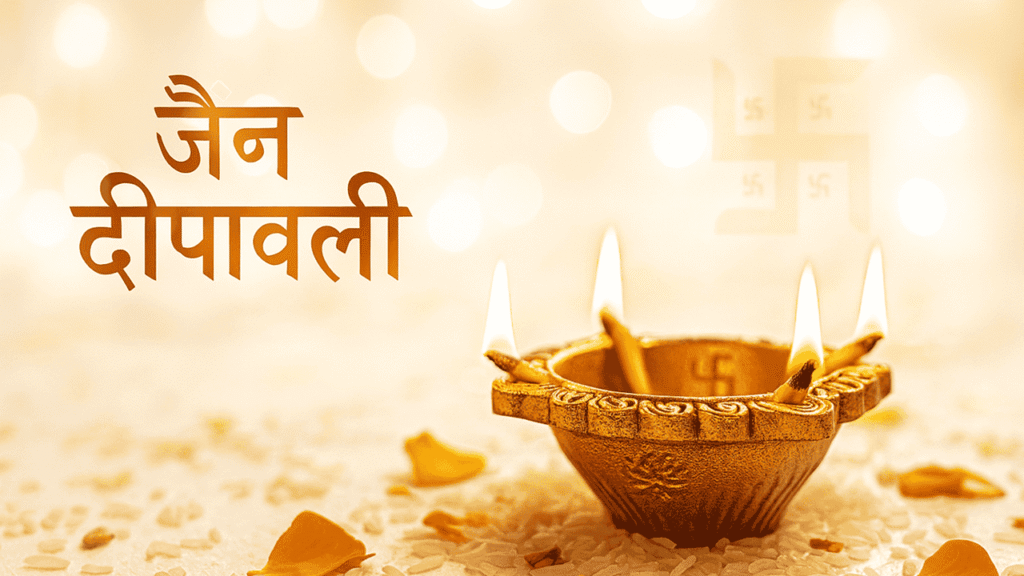
Diwali Worship at Home: After noon and before dusk, worship is performed at home for Bhagwan Mahavir and primarily Gautam Swami with 64 lights, symbolizing the Kevalgyan and 64 Riddhis attained by Gautam Swami at dusk. Devotees perform Jin Puja in their homes with 16 ghee lamps, each with four wicks, thus totaling 64 flames. They pray for the attainment of omniscience and express the sentiment that the light of right knowledge may spread throughout the world, and the darkness of ignorance be destroyed.
Ledger and Business Rituals: In this ritual, the sacred yellow rice (pushpa) left over after the worship is taken. While reciting the 'Mangalashtak' hymn, this rice is sprinkled (kshepan) on ledgers, shops, business establishments, vehicles, and homes. This act is performed with a profound sentiment, described as 'the spirit of devotion to knowledge and its propagation'. Superficially, this ritual might seem like a common practice for business prosperity, as is prevalent in many other cultures. However, its inner meaning is much deeper. It is not merely a prayer for material gain or good fortune but a resolution to 'sanctify commerce' itself. When rice sanctified after the worship of knowledge is sprinkled on the ledger, it symbolizes that the devotee is placing their financial transactions under the governance of 'right knowledge'.
Chapter 6: The Dawn of a New Era - The Beginning of the Jain New Year
The Jain New Year begins on the day after Diwali, on Kartik Shukla Pratipada. Its timing reveals a deep philosophical truth.
The Significance of Kartik Shukla Pratipada
The commencement of the new year on the day following Bhagwan Mahavir's Nirvana signifies that in Jainism, the source of authority is not an individual but the principles laid down by them.
A New Beginning of Jin Governance: The end of Bhagwan Mahavir's physical presence (body) marks the true beginning of his governance (the era of his teachings). The new year is not for mourning the departure of an individual but for celebrating the dawn of a new era in the light of the eternal path he gave. As long as the Tirthankara was physically present, he was the direct source of knowledge. With his Nirvana, the words he spoke (Agama) became the supreme guide for the community. This is a significant transition from person-centric authority to principle-centric authority.
The Decision of the Ganarajas: According to a popular narrative, to commemorate the lamp of knowledge that was extinguished with Bhagwan Mahavir's Nirvana, the 18 Ganarajas (confederate kings) of Kashi-Koshal lit lamps together and resolved that from now on, they would guide their governance not by a physical king but by the word of Mahavir. With this resolution, a new calendar, the 'Veer Nirvan Samvat', was initiated.
The Jain Perspective on Govardhan Puja
According to one belief, the Govardhan Puja celebrated the day after Diwali also has a symbolic connection to the Jain tradition. In Jain scriptures, the 'Jinavani' (the Lord's word) is compared to a 'Gau' (cow). Just as a cow nourishes with her milk, the Jinavani nourishes the soul with the nectar of knowledge. After Bhagwan Mahavir's Nirvana, Gautam Gandhar restarted the flow of Jinavani through his divine sermon from Kartik Shukla Pratipada. Thus, there was a 'Vardhan' (enhancement, worship) of the 'Gau' (Jinavani). This interpretation connects Govardhan Puja not to a physical mountain or event but sees it as a spiritual symbol of the enrichment of the tradition of knowledge.
This tradition shows that true light lies not in the presence of an individual but in the knowledge given by them. The Veer Nirvan Samvat remains a living symbol of the unique historical and philosophical identity of the Jain community even today.
Conclusion: The Festival of Igniting the Inner Lamp
From the detailed analysis above, it is clear that Jain Diwali, or Veer Nirvanotsav, is a multifaceted festival that is a wonderful confluence of a historical event (Bhagwan Mahavir's Nirvana), a profound philosophical principle (the victory of knowledge over ignorance), and a continuous spiritual practice (self-purification). It is a historically authenticated celebration, supported by archaeological evidence like the Badli inscription and classical texts like the Harivansh Purana.
Its core message is a profound journey from materialism to spirituality, from darkness to light, and from bondage to liberation. The symbolism of the Nirvan Laddoo, the concept of Moksha Lakshmi, and the knowledge-centric worship methods all resonate with the fundamental principles of Jainism.
Ultimately, true Diwali lies not so much in lighting countless lamps outside, but in following the example of Bhagwan Mahavir and Gautam Gandhar to ignite the inner lamp of knowledge, detachment, non-violence, and equanimity within oneself. It is a festival of self-realization, reminding us annually that our ultimate goal is to eradicate the darkness of karmas, manifest the natural light of the soul, and attain Nirvana. It is far more a festival of inner practice than of outer celebration.
बहुत ही सुन्दर विवरण