Girnar and Lord Neminatha: An Untold Ancient Mystery
Introduction
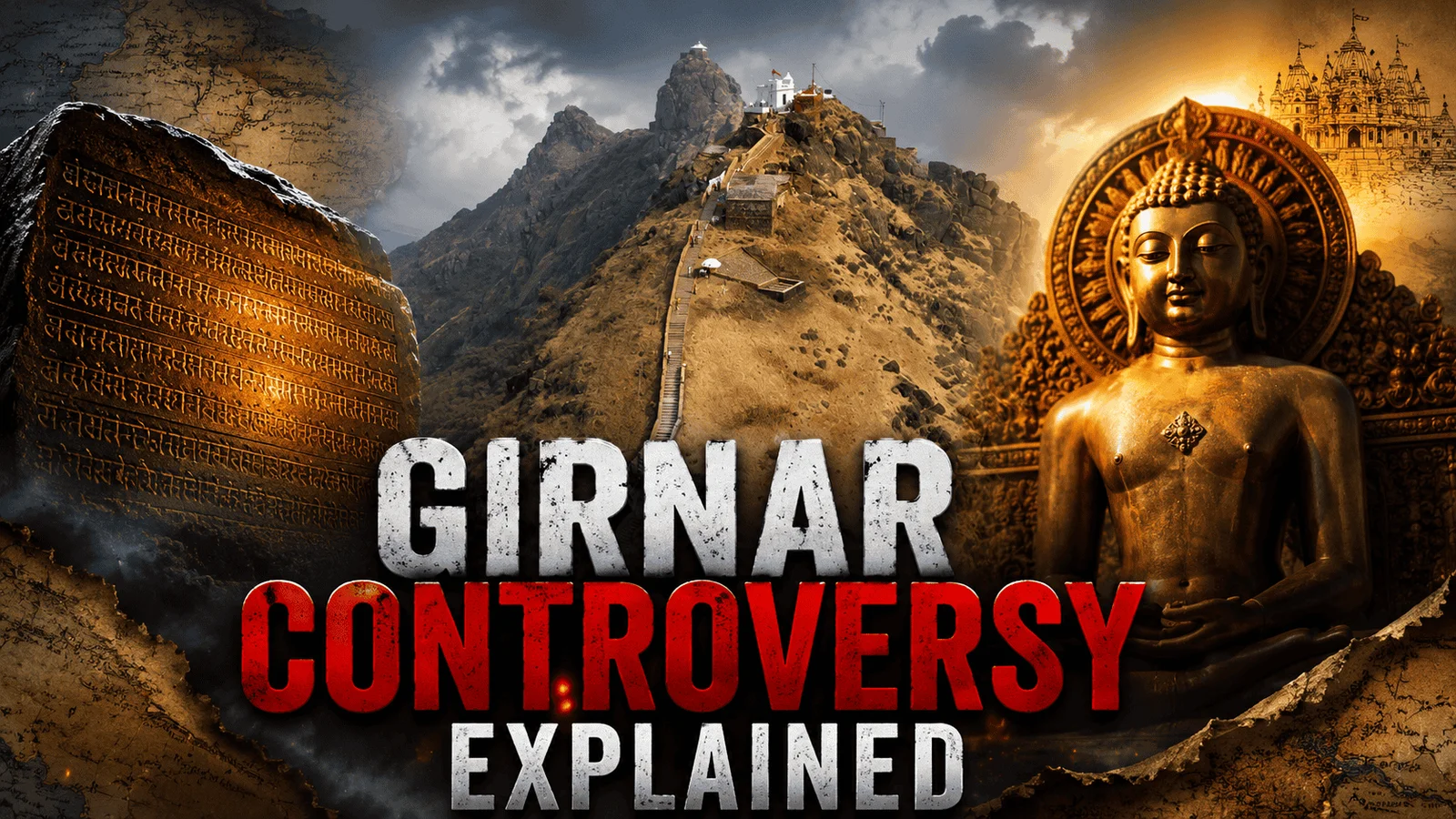
On the spiritual map of the Indian subcontinent stands a mountain that is unique not only for its height but also for its prehistoric antiquity. Located in Junagadh, Gujarat, Mount Girnar—referred to in ancient texts as 'Urjayanta' or 'Raivataka'—is geographically older than the Himalayas. According to Jain cosmology, this mountain is the Nirvana Bhumi (the land of salvation) of Lord Neminatha, the 22nd Tirthankara of the current Avasarpini Kala (the descending cycle of time). But is the significance of Girnar limited only to faith? Historical research and archaeological evidence tell a completely different story. Let us investigate the mysteries surrounding Girnar and Lord Neminatha that hold the potential to redefine the depth of Indian history.
1: Krishna’s Guru ‘Ghor Angiras’ and Arishtanemi in the Vedas
The most astonishing fact for historians and researchers is found in the Chandogya Upanishad. This text mentions 'Ghor Angiras' as the guru of Lord Krishna, who instructed him in the principles of non-violence (Ahimsa) and austerity (Tapa). Modern Indologists and scholars, including Hermann Jacobi, believe that 'Ghor Angiras' was none other than Tirthankara Neminatha himself.
- Evidence from the Yajurveda: The former President of India and philosopher, Dr. S. Radhakrishnan, has highlighted that the Yajurveda explicitly pays homage to three Tirthankaras—Rishabhadeva, Ajitanatha, and Arishtanemi (Neminatha).
- The Vedic Mantra: Even today, during the Svasti Vachan (auspicious chants) in Hindu rituals, this mantra is recited: "Svasti nastarkshyo arishtanemih", which stands as proof of this great soul's historical acceptance.
- The Pride of the Yadu Dynasty: According to Jain Puranas (such as the Harivamsa Purana), Neminatha was the son of King Samudravijaya of Dwarka and the cousin of Lord Krishna. His historicity bridges both the Vedic and Shramana traditions.
2: The Wedding That Made ‘Girnar’ a Global Pilgrimage Site
The course of history is often altered by wars, but the moral history of India was transformed by a single act of 'renunciation'. The marriage of Prince Neminatha was arranged with Rajulmati, the daughter of King Ugrasena of Junagadh. As the wedding procession advanced, Neminatha heard the cries of thousands of helpless animals confined in enclosures, waiting to be slaughtered for the royal wedding feast.
"If the foundation of personal happiness rests upon the blood of the innocent and the destruction of compassion, then such happiness is a path to spiritual downfall. Empathy toward all living beings is the true essence of religion."
At that very moment, the prince turned his chariot toward the peaks of Girnar and embraced Digambara Diksha (monastic renunciation). This pivotal event firmly established Girnar as a sacred pilgrimage site and solidified the global philosophy of 'Ahimsa Parmo Dharma' (Non-violence is the supreme religion) in India.
3: A Spiritual Power Center Older Than the History
The spiritual geography of Mount Girnar (Urjayanta) is unparalleled. In Jainism, it is revered as a Siddha Kshetra (a land of liberation). Out of the five Kalyanakas (auspicious life events) of Lord Neminatha, three—Diksha (renunciation), Kevalajnana (omniscience), and Moksha (salvation)—took place on this very mountain. The five major peaks (Tonks) here bear witness to the rigorous austerities performed by Jain monks:
The Five Peaks of Girnar
| Peak (Tonk) | Jain Belief and Historical Evidence |
|---|---|
| First Peak | The main temple of Lord Neminatha, Rajulmati’s cave, and the footprints of Acharya Kundakunda. Inscriptions dating back to Vikram Samvat 1249 are found here. |
| Second Peak | The Nirvana Bhumi (land of salvation) of the Yaduvanshi monk Aniruddha Kumar, and the shrine of Mata Ambika (the Yakshini of Lord Neminatha). |
| Third Peak | The Moksha Sthali (place of salvation) of Monk Shambu Kumar, who destroyed his karmas here through intense austerities. |
| Fourth Peak | The Nirvana Bhumi of Pradyumna Kumar, the son of Lord Krishna. |
| Fifth Peak | The Highest Peak (Urjayanta): This is where Lord Neminatha attained Diksha, Kevalajnana, and Nirvana. It is the core energy center of the mountain. |
4: The ‘Spiritual University’ of 720 Million Monks
Mount Girnar was not merely a pilgrimage site, but the largest 'spiritual university' of ancient times. According to ancient Prakrit texts such as Siri Bhuvalaya and Nirvana Kanda, a total of 720 million and 700 monks attained Moksha (salvation) from this holy mountain. A famous ancient Prakrit verse (gatha) explicitly highlights this: "Nemisami Pajjunne Sambukumar Taheva Aniruddho, Bahattar Kodio Ujjante Sattasaya Siddha." This data demonstrates that in the centuries BCE, Girnar was a massive institutionalised spiritual sanctuary where thousands of monks and nuns remained absorbed in deep meditation and research. According to the Kalpasutra, the Sangha (order) of Lord Neminatha comprised 18,000 monks (Sadhus) and 44,000 nuns (Sadhvis).
5: “Guru Dattatreya” or “Guru Datta”? The Truth Behind the Historical Name
The ongoing dispute regarding the fifth peak of Girnar finds its roots in 'phonetic manipulation'. According to historical documents, the most prominent among the 11 Ganadharas (chief disciples) of Lord Neminatha was Varadatta, who was also known as 'Datta' or 'Dhatarie'.
- Historical Evidence: The renowned 19th-century British archaeologist James Burgess (1874–75), in his official publication "Report on the Antiquities of Kathiawad and Kachh", explicitly recorded that the fifth peak bears the footprints (Paduka) of Lord Neminatha, and at that time, a Digambara (naked) Jain monk was tending to them.
- The Linguistic Shift: Originally, this peak was referred to as 'Guru Dhatarie Shikhar' (the peak of Guru’s disciple Datta). Later, exploiting the phonetic similarity of the word 'Datta', it was conflated with 'Dattatreya'.
- Exposing the Fabrication: Scholars like James Burgess and James Fergusson warned that later additions, such as the Girnar Mahatmya of the Skanda Purana, were locally fabricated to claim control over this ancient Shramana site.
6: Custodian of Vanishing Knowledge – The Miracle of ‘Chandra Gufa’
The composition of Shatkhandagama—the most foundational philosophical scripture of Jainism—took place right in the lap of Girnar. In the 1st century CE, when the oral tradition of the Jain Agamas was on the verge of vanishing, Acharya Dharasena was practicing deep austerities inside the 'Chandra Gufa' (Moon Cave) of Girnar. Recognizing the crisis, he summoned two brilliant monks from South India (Pushpadanta and Bhutabali) and imparted to them the remaining knowledge of Vyakhyaprajnapti and Drishtivada (the 12th Anga). Had it not been for these caves of Girnar and Acharya Dharasena, the foundational textual bedrock of the Digambara Jain tradition would have been lost to humanity forever.
Conclusion: Safeguarding a Timeless Legacy
The history of Girnar and Lord Neminatha stands firm and clear like an inscription in stone, validated by the crucible of evidence, inscriptions, and archaeological reports. From Colonel James Tod to James Burgess, every impartial observer has recognized this site as the supreme center of the Jain Shramana tradition.
Today, as we look toward this sacred mountain, history poses a profound question to us: "Do we possess the courage to safeguard the authenticity of our ancient heritage and accept it in its original historical form?" Girnar is not merely a mountain; it is a living document of India's non-violent and scientific consciousness. Protecting its sanctity and historical integrity is our collective responsibility.
Download Research PDF with Reference Links
Discussion
No comments yet. Be the first to start the discussion!