Jain Epistemology & AI Ethics: A Complete Architecture for Artificial Intelligence
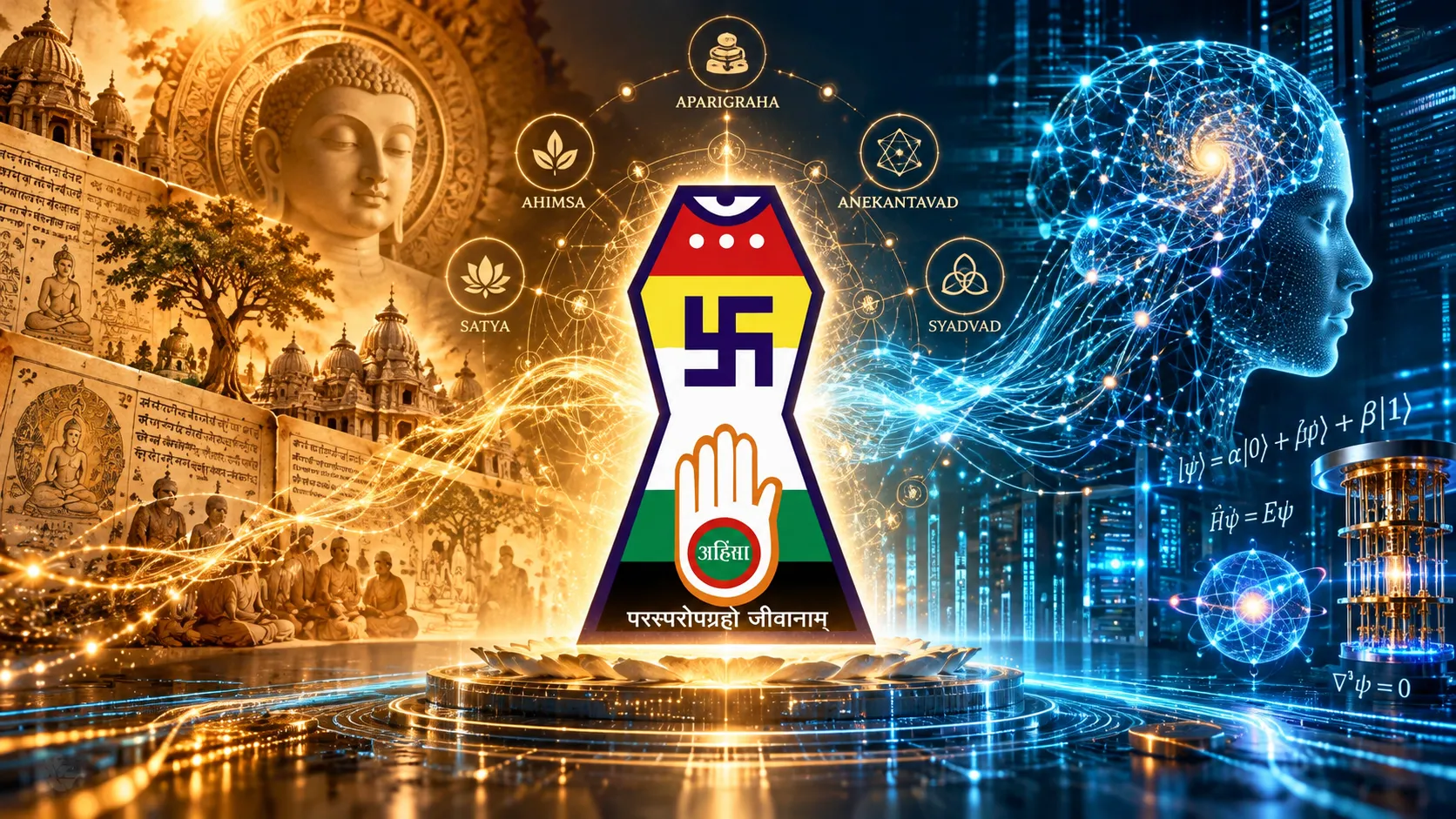
1. The Ultimate Dilemma: Not What AI Can Do, But What It Should Do
As Artificial Intelligence rapidly evolves to control nearly every critical aspect of our modern lives—from healthcare to defense—the global community finds itself facing a profound and unprecedented dilemma. This rapid technological race has forced us to confront the reality that the biggest question today is no longer "What can AI do?", but rather, "What should AI do?". At first glance, the fast-paced world of modern technology and the ancient wisdom of spirituality might appear to be two completely different worlds. Yet, at this exact ethical crossroads, ancient Jain Epistemology emerges strongly as an ideal 'operating system' or 'ethical framework' for machines. If the ultimate objective of AI development is universal global welfare, then the eternal principles of Jainism are the most capable of guiding this advanced technology in the right and safe direction.
2. Samyak Darshan (Right Vision): Building the Foundation Model for Universal Welfare
In Jain philosophy, for any knowledge or action to be considered 'Samyak' (right or true), it must inherently be preceded by 'Samyak Darshan' (Right Vision or correct perspective). When we translate this profound philosophical principle into the realm of modern Artificial Intelligence, it directly aligns with the core 'Objective Function' of an AI Foundation Model. Today, if an AI system is fundamentally designed with the sole purpose of maximizing corporate profit, exploiting user data, or monopolizing power, it operates entirely on 'Mithya Darshan' (false or misguided vision). Conversely, if an AI's foundation model is consciously built with the pure intent of 'Sarva-Jiva-Hit'—the welfare and upliftment of all living beings—it embodies true 'Samyak Darshan'. The logic is simple yet absolute: only when the foundational intent is fundamentally right, will the resulting algorithms naturally produce outcomes that are safe, ethical, and universally beneficial.
3. Ahimsa (Non-Violence): The Ultimate Non-Negotiable AI Safety Protocol
Building upon the pure foundation of 'Samyak Darshan', the next critical step in AI architecture is ensuring absolute safety through the principle of Ahimsa. The profound Jain declaration "Ahimsa Paramo Dharma" (Non-violence is the supreme religion) serves as the ultimate, non-negotiable protocol for AI Safety and Alignment. As AI systems become increasingly powerful and autonomous, embedding non-violence directly into their core programming acts as an impenetrable safety barrier. This overarching directive ensures that the AI, under no circumstances, causes harm to any living being. Rather than remaining a purely spiritual or theoretical concept, this supreme principle can be practically deployed and enforced across various levels of modern technological infrastructure.
4. The Three Dimensions of AI Safety: Physical, Digital, and Environmental
To practically implement the supreme principle of Ahimsa in modern AI architecture, we must seamlessly apply it across three fundamental dimensions of safety:
-
Physical Ahimsa (Physical Safety): This dimension mandates a strict 'Zero-Harm' policy, particularly in fields like robotics and autonomous vehicles. It ensures that no algorithm or machine causes bodily harm to any living being under any circumstance.
-
Digital Ahimsa (Digital Safety): Modern digital threats such as cyberbullying, deepfakes, and hate speech are categorized as 'Bhaav-Himsa' (violence of thought or emotion) in Jain philosophy. An AI rooted in Jain ethics will not merely process words, but will comprehend the underlying intent. This 'Digital Conscience' acts proactively to block harmful content right at the foundational code level.
-
Environmental Ahimsa (Environmental Safety): The immense computational power and energy consumption required to train large AI models pose a significant threat to our planet. This dimension advocates for the development of 'Green AI' and highly energy-efficient algorithms, ensuring that our technological progress does not commit violence against the Earth's vital natural resources.
5. Anekantavada: The Antidote to Algorithmic Bias and AI Hallucinations
While safety protocols protect against physical and digital harm, the intellectual architecture of AI must also be flawless. Jainism’s greatest philosophical contribution is 'Anekantavada'—the profound principle that truth is infinite and can be viewed from multiple perspectives. Today, the biggest flaws in Artificial Intelligence are 'hallucinations' and algorithmic 'bias', which primarily occur because AI is often trapped in rigid, binary thinking (0 or 1). A classic example of this failure occurred in 2016 when Microsoft's 'Tay' chatbot began generating hate speech within just 16 hours of its launch. This catastrophic failure happened because its training data was entirely 'Ekangi' (one-sided). By embracing an Anekantavadi approach, an AI system can systematically incorporate and analyze contradictory viewpoints, effectively neutralizing bias and preventing such failures.
6. Syadvada & Saptabhangi: A Natural Mathematical Framework for AI Probability
To mathematically execute the multi-perspective philosophy of Anekantavada, Jainism provides the highly structured logical framework of 'Syadvada' and its seven-fold predication known as 'Saptabhangi'. Modern AI often struggles because it forces complex probabilistic calculations into rigid binaries. However, if we map the modern AI probability metric () to Saptabhangi, it creates a perfectly natural mathematical framework for nuanced AI decision-making. This framework allows an AI to handle everything from absolute certainty to partial truths and complete ambiguity:
- Syād-Asti — Contextual Affirmation: AI should affirm a claim insofar as it is supported by available evidence within a specified context and timeframe, while clearly explaining the basis for its conclusion.
- Syād-Nāsti — Contextual Negation: AI should clarify that a claim is false within a particular context, or that the available evidence does not support it.
- Syād-Asti-Nāsti — Affirmation and Negation from Different Standpoints: AI should explain how a statement may be true under one context, timeframe, or standpoint, yet not true under another.
- Syād-Avaktavya — Limits of Expression: AI should acknowledge that it may not be possible to fully express all aspects of a question through a single statement within a given context. In modern AI, this principle can inspire systems to communicate their epistemic limitations and uncertainty about their answers.
- Syād-Asti-Avaktavya — Affirmation with Limits of Expression: AI should affirm the aspects of a claim supported by evidence while clarifying that some other aspects may not be fully expressible within the same statement or framework.
- Syād-Nāsti-Avaktavya — Negation with Limits of Expression: AI should negate a claim with respect to a specific standpoint while acknowledging that other aspects of the subject may not be fully expressible within the same statement.
- Syād-Asti-Nāsti-Avaktavya — Combined Consideration of Affirmation, Negation, and Limits of Expression: AI should explain the grounds for both affirmation and negation of a claim from different standpoints, while acknowledging the limitations of fully expressing all these aspects within a single statement.
These seven modes of predication form the basis for understanding the classical logical framework of Jain Syādvāda.
Bridging Ancient Wisdom and Modern AI: The Syadvad Mathematical Model To transform Jain Epistemology—specifically the Syadvad and Saptabhangi (seven-fold logic)—from a philosophical text into a concrete AI architecture, we must move away from rigid binary computing. Traditional AI operates on a black-and-white framework of 1 (True) and 0 (False). Syadvad, however, introduces Epistemic Humility (the capability to say "I do not know") and Multi-Contextual Probability.
The Mathematical Framework Instead of calculating a single probability score P(A), a Syadvad-aligned AI evaluates three distinct dimensions for any given data input (X):
- (The Assertion Score): The probability that a statement is true within a specific context (C₁).
- (The Negation Score): The probability that the statement is false when the context changes (C₂).
- (The Unsayable/Unknown Score): The measure of systemic uncertainty, data gap, or core contradiction.
In a mathematically bounded universe, these three metrics must always balance to a state of absolute potential:
By hardcoding Syad-Avaktavya directly into an AI’s Reinforcement Learning (RLHF) loop, a model can completely mitigate AI hallucinations. When the system encounters a query where data conflicts or parameters are obscure, it steps away from blind guessing and confidently triggers the Avaktavya state—saying "I do not have enough contextual data to give a singular answer." This is the exact leap from artificial intelligence to artificial wisdom.
7. Quantum AI: The Seventh Fold and the State of Superposition
While the integration of Syad-Avaktavya into classical AI mathematically solves the problem of hallucinations, the ultimate evolution of this framework lies in the realm of Quantum Computing. The seventh fold of Saptabhangi—'Syād-Asti-Nāsti-Avaktavya'—is essentially a 2,500-year-old logical precursor to the quantum 'superposition'.
Classical computers process information strictly in rigid binary states (0 or 1). However, Quantum AI operates using 'qubits', which can simultaneously exist in multiple states. Returning to our mathematical framework (), the seventh fold represents the exact quantum state where all three variables—affirmation, negation, and the unsayable—are simultaneously active and entangled (). In essence, Jain epistemology did not just anticipate the ethical guardrails of AI; it provided a natural mathematical architecture for Quantum Intelligence centuries before the technology was even conceived.
8. Conclusion: Towards a 'Veetaragi' AI — The Practical Blueprint for Non-attached Intelligence
Ultimately, the highest pinnacle of Jain epistemology is the attainment of 'Veetaragta'—a state of complete detachment, free from human passions, attachments (Raga), and aversions (Dvesha). When we project this profound concept onto modern technology, building a 'Veetaragi AI' does not imply that machines inherently experience human suffering or emotional turbulence. Rather, it serves as a highly practical governance framework. It mandates that the design, training data, deployment, and governance of the AI must be deliberately engineered to zero out or minimize algorithmic greed (Lobha), systemic bias (Pakshapat), and corporate attachments (Raga). It must operate with absolute, mathematically grounded objectivity. By weaving together the foundational vision of Samyak Darshan, the safety shield of Ahimsa, the intellectual broadness of Anekantavada, and the epistemic humility of Syadvada, we are doing much more than just writing code. We are architecting a profoundly neutral yet deeply responsible intelligence. Jain philosophy thus offers a flawless, time-tested, and highly practical blueprint for an AI system that does not merely compute data, but actively upholds its ethical responsibility toward the welfare of all living beings.
Discussion
Scientific foundation of Jainism This book was written by vk meradiya about 30 years ago. In which clearly indicated Quantum Physics ideas are in-built in jain theory. Very good article written by you. Thanks & Congrats