Jain Philosophy: Fundamental Eternal Truth, Universal Law, and Supreme Science
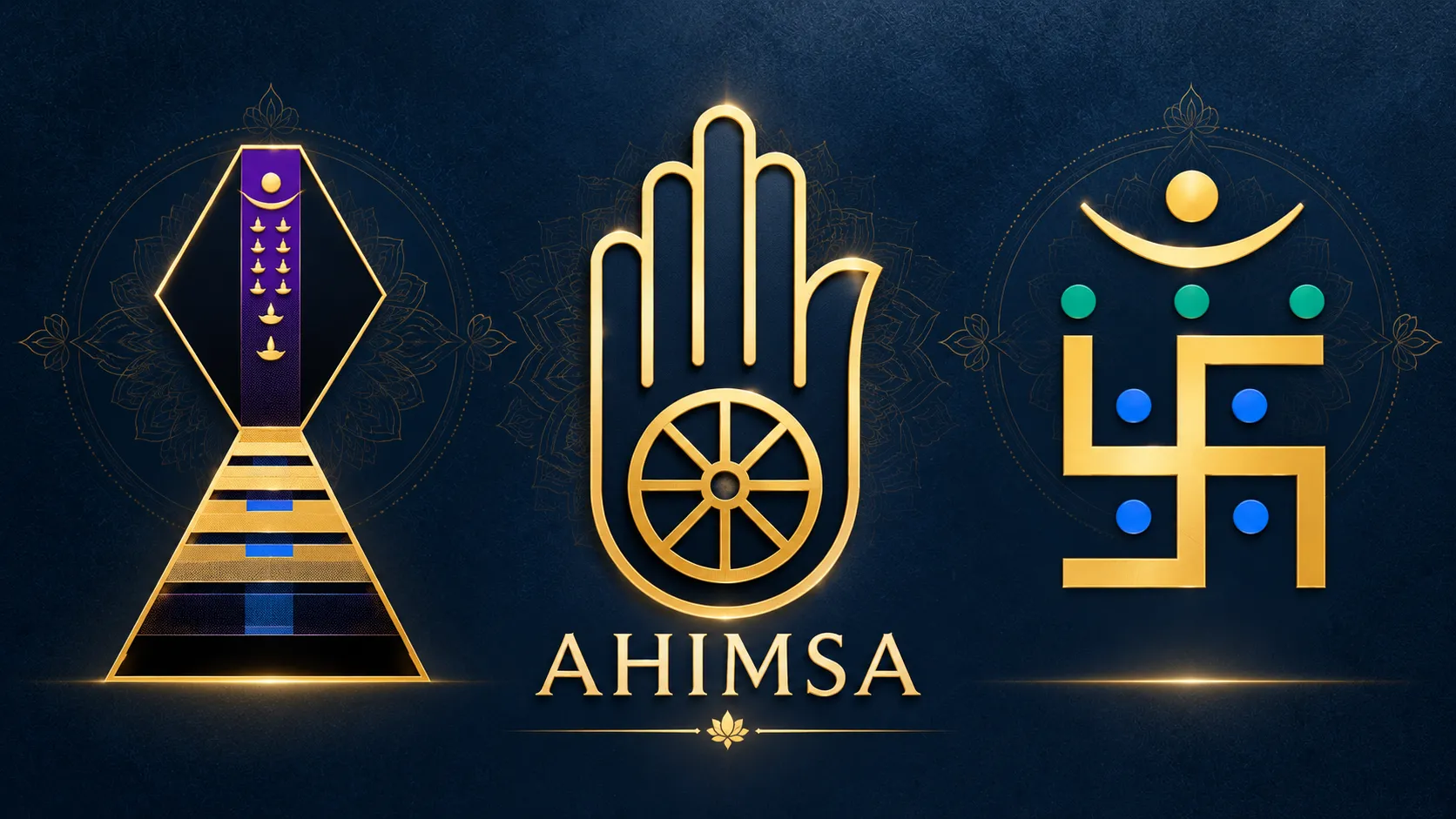
1: Eternity and Fundamental Identity of Jain Philosophy
1.1 Dispelling Myths: Founder and Origin
Two fundamental misconceptions are prevalent in modern discourse regarding the identity of Jain philosophy. First, that Jainism is a branch or a reformist movement of the Hindu (Brahmanical) religion; and second, that this religion was founded either by Lord Mahavira about 2500 years ago or by Lord Rishabhdev about 5000 years ago. This research-based analysis refutes both these concepts based on irrefutable evidence and establishes the actual, eternal, and independent identity of Jain philosophy.
Lord Mahavira (approx. 599-527 BCE) was not the 'founder' of Jainism; he was the 24th and last Tirthankara (ford-maker) of this time cycle (the current Avasarpini era). 'Tirthankara' means one who himself crosses the ocean of worldly existence and establishes a 'Tirtha' (path) for others to cross over. Lord Mahavira was a great propagator of this eternal philosophy, not its originator.
The historicity of Jain philosophy is far more ancient than Lord Mahavira. The 23rd Tirthankara, Lord Parshvanatha, has been accepted by prominent historians as an undisputed historical figure, whose period is determined to be about 250 years before Lord Mahavira (i.e., around the 8th-9th century BCE). Even the oldest Pali texts of Buddhism contain clear references to the 'Nirgrantha Dharma' propounded by Lord Parshvanatha and the already established Nirgrantha community. This is significant external evidence proving that Jainism existed as a well-established and organized philosophical tradition centuries before the birth of Lord Mahavira.
The notion that Jainism is a 'branch' of Hinduism is the result of a failure to understand the fundamental difference between the two primary streams of Indian philosophy. Jain philosophy is not a part of the Hindu (Brahmanical) tradition, but rather represents a completely independent and parallel stream. The Supreme Court of India has also affirmed in various judicial decisions that Jainism is a distinct and independent religion, not a sect or part of Hinduism.
(A link to the video analysis based on this complete blog post is also available and can be accessed from the below link.)
1.2 The Two Fundamental Streams of India: Shramana vs. Brahmana
Ancient Indian intellectual history can be divided into two main, parallel, and philosophically distinct streams:
-
Brahmana Tradition: This stream considers the Vedas to be supreme, of divine origin (apaurusheya), and the ultimate authority. Its philosophy is primarily based on sacrificial rituals and the authority of the Vedas.
-
Shramana Tradition: This stream does not accept the authority of the Vedas as absolute proof. The word 'Shramana' is derived from the root 'Shram', which means 'to exert effort' or 'to toil'. This tradition considers individual spiritual effort (purushartha), asceticism (tap), self-denial, and the Law of Karma as the sole means of spiritual liberation.
Jain philosophy, along with Buddhist philosophy and the Ajivika tradition, is a major and fundamental pillar of this ancient 'Shramana tradition'.
Jain scholars and many modern historians believe that the Shramana tradition did not emerge as a 'protest movement' or 'reform' against the Brahmana tradition, but is an independent, original, and possibly even older stream than the Vedic tradition. It is one of the two parallel philosophical systems born on Indian soil, whose worldview and path to liberation are fundamentally different. Therefore, calling Jain philosophy a 'branch' of any other stream is a flawed interpretation of the entire history of Indian philosophy.
1.3 Antiquity: Archaeological and Literary Evidence The Jain tradition traces the beginning of its current time cycle to the first Tirthankara, Lord Rishabhanatha (also known as Adinatha). This antiquity of Jain philosophy is not merely a matter of faith; robust archaeological and literary evidence is available to support it.
Archaeological Evidence: Many prominent scholars, including Indologists like Dr. Heinrich Zimmer, place the roots of Jainism in India's prehistoric, 'pre-Aryan' culture. Certain seals and artifacts excavated from the Indus Valley Civilization (approx. 3300–1300 BCE) corroborate this connection:
-
The Bull (Vrishabha) Symbol: The symbol of a bull (Vrishabha) is found in abundance on Indus Valley seals. In the Jain tradition, the 'Vrishabha' is the official emblem of Lord Rishabhanatha.
-
Kayotsarga Posture: Some terracotta figurines recovered from Mohenjo-Daro and Harappa are depicted in the 'Kayotsarga' posture—that is, standing still and meditating after renouncing attachment to the body. This meditation posture is a distinct and extremely ancient hallmark of Jain Shramanas.
Dr. Heinrich Zimmer clearly stated: "There is truth in the Jains' idea that their religion goes back to a remote antiquity, this antiquity being of the pre-Aryan period, which has been dramatically illuminated by the discovery of Stone Age cities in the Indus Valley."
Literary Evidence: The strongest 'external' evidence of Jain philosophy's antiquity is found within the Brahmanical (Hindu) scriptures themselves. If Jainism were a later branch of Hinduism, its Tirthankaras should not have been mentioned in the oldest Vedic literature. However, the facts prove otherwise:
-
Yajurveda: This ancient Veda mentions the names of three Tirthankaras—Rishabha, Ajitanatha, and Arishtanemi.
-
Shrimad Bhagavata Purana: This major Vaishnava Purana explicitly acknowledges that Lord Rishabhdev preached the 'Jain path' (the path of non-violence and detachment).
This evidence irrefutably proves that the tradition of Lord Rishabhanatha was so ancient and influential that even the Vedic tradition gave them a place in its literature. This is evidence of 'absorption', not 'origination'. It proves the 'pre-Vedic' status and antiquity of the Jain Tirthankara tradition.
2: Various Names of Jainism: Historical and Philosophical Evidence
The profundity and historical journey of Jain philosophy are evidenced by the various names by which it has been recognized across different eras and contexts. This diversity of names is not a sign of confusion, but rather an expression that highlights different aspects of the philosophy—such as its propounders, the qualities of its followers, its ultimate goal, and its core principles.
2.1 Philosophical Names: 'Jin Dharma' and 'Vitraag Dharma' These two names define the spiritual essence of Jain philosophy:
-
'Jin Dharma': The word 'Jain' is derived from 'Jin'. 'Jin' literally means 'Victor'. This title is given to those souls who have achieved complete victory over their internal enemies—specifically anger, pride, deceit, and greed. Those who have conquered their senses and mind are called 'Jitendriya' or 'Jin'. The path preached (taught) by these 'Jin' Lords is 'Jin Dharma'. This name focuses on the 'agency' and 'process' of the philosophy—that is, it is the path to becoming a 'Victor'.
-
'Vitraag Dharma': 'Vitraag' means 'Veet' (beyond) + 'Raag' (attachment). Meaning, one who is completely beyond 'attachment' and 'aversion'. In Jain philosophy, the supreme definition of God (Arihant and Siddha) is that they are 'Vitraagi' (completely detached) and 'Sarvagya' (omniscient). This religion is not based on a 'creator' or an 'incarnation', but is based on the supreme state of 'Vitraagata' and the 'omniscient' knowledge manifested from that state. This name reflects the purity of the philosophy's 'source' and 'ideal'.
2.2 Historical Name: 'Nirgrantha Dharma' This is the oldest historical name of Jainism, which is abundantly used in the Pali Canon texts of Buddhism. In these texts, Lord Mahavira is consistently addressed as 'Nigaṇṭha Nātaputta'—meaning 'the Nirgrantha of the Jnatri (Nata) clan'. The word 'Nirgrantha' (Nir-granth) means 'knotless' or 'free from bonds'. Philosophically, this 'knot' (granthi) is a symbol of 'possession' (parigraha) and 'attachment' (aasakti). A 'Nirgrantha' is one who has untied all types of internal and external knots. This 'Nirgrantha Dharma' is the path followed by monks who are completely free from all internal attachments and external possessions, symbolizing a state of complete renunciation and non-possession (akinchanya). This name reflects the pinnacle of austerity and detachment of the Jain Shramanas.
2.3 Epigraphic Name: 'Arhat Dharma' An invaluable epigraphic proof of the historical antiquity of Jainism is found in the famous 'Hathigumpha Inscription' of Emperor Kharavela of Kalinga (modern-day Odisha), which dates back to approximately the second or first century BCE. Although the exact phrase "Arhat Dharma" does not appear together in this inscription, the very first line of the inscription begins with the auspicious invocation "Namo Arihantanam"—meaning 'Obeisance to the Arihantas'. 'Arihant' (Arhat) means 'those who are worthy of worship' or 'those who have destroyed their internal enemies (Ari)'. This inscription describes King Kharavela as a 'Dharmaraj' (King of Religion) and reflects his deep devotion to the Arihantas. It is clear that the religion he was practicing and protecting was propounded by the 'Arihantas' and centered on their veneration. Therefore, terming it 'Arhat Dharma' (Path of the Arhats) is completely meaningful and supported by the inscription.
2.4 Descriptive Names: 'Shramana', 'Ratnatraya', and 'Sanatana' Some names describe the practice and structure of this philosophy:
-
'Shramana Dharma': As mentioned earlier, this name reflects the practice of the followers—the path of those making 'ascetic effort' (shram) for liberation.
-
'Ratnatraya Dharma': This is the technical name for the entire structure of Jain philosophy. 'Ratnatraya' means the 'Three Jewels', which are the only path to liberation: Samyag Darshana (Right Faith), Samyag Gyana (Right Knowledge), and Samyak Charitra (Right Conduct).
-
'Dasalakshana Dharma': Because it is based on the ten characteristics of Dharma—Supreme Forgiveness, Humility, Straightforwardness, Purity, Truth, Restraint, Penance, Renunciation, Non-attachment, and Celibacy—it is called 'Dasalakshana Dharma'.
-
'Sanatana Dharma': Jain philosophy is also called 'Sanatana Dharma', but its 'eternity' (sanatanata) is not based on knowledge given by a creator God. This philosophy is 'Sanatana' because it is based on the eternal laws of the universe and the 'inherent nature' (vastu-svabhāva) of substances. Substances like soul, matter, and time are eternal, therefore their nature and the path to liberation from them are also eternal or 'Sanatana'. Here, instead of a Supreme God, there are Tirthankaras acting as Supreme Teachers who have been revealing these eternal laws since beginningless time.
2.5 Various Names of Jainism: Sources and Meanings
The following table summarizes these various names:
Name | Literal Meaning | Philosophical Meaning | Primary Source / Context |
|---|---|---|---|
Jin Dharma | Of the Victor | Path of those (Jinas) who have conquered attachment and aversion | Philosophical |
Vitraag Dharma | Free from attachment and aversion | Path propounded by supreme detachment (Vitraagi Omniscient) | Philosophical |
Nirgranth Dharma | Knot-free (without knots) | Religion of monks completely free from all possessions and bonds | Historical |
Arhat Dharma | Of the worthy one | Path taught and venerated by the Arihantas | Epigraphic (Hathigumpha Inscription) |
Shraman Dharma | One who makes ascetic effort (Shram) | Path based on penance, self-knowledge, and the law of karma | Philosophical Stream |
Ratnatraya Dharma | Three Jewels | Path of liberation in the form of Right Faith, Knowledge, and Conduct | Doctrinal / Agamic |
Sanatana Dharma | Eternal | Based on the eternal (inherent) nature of the soul and the 6 substances (Shat-Dravya) | Philosophical |
3: Unique Concepts of Jainism: Puranas and Principles
3.1 'Kshatriya Dharma': The Varna System of Tirthankaras
A unique and profound concept of Jain philosophy is that all 24 Tirthankaras invariably take birth in the 'Kshatriya varna' (warrior class). This concept is often viewed merely as a social classification, but its basis in Jain Cosmology is very profound.
The word 'Kshatriya' means 'one who protects'. By establishing Dharma, Tirthankaras protect the entire world from internal (attachment and aversion) and external enemies. Their birth in the Kshatriya varna is a 'cosmological necessity'.
Its root connection is with the eternal arrangement of 'Videha Kshetra'. According to Jain cosmology, 'Mahavideha Kshetra' is an 'eternal land of action' where there is no change of the time cycle (unlike the cycle of happiness and misery in our Bharat Kshetra) and where the path to liberation is always open.
Since the arrangement of Videha Kshetra is eternal, its 'varna system' (varna vyavasthā) is also 'beginningless and endless' (anadinidhan). According to Jain Puranas, when the era of pleasure and no action (bhogabhumi) ended and the era of action (karmabhumi) began in our 'Bharat Kshetra', the first Tirthankara, Lord Rishabhanatha (Adinatha), provided a structured organization to society.
According to the Adipurana authored by Acharya Jinasena, Lord Rishabhanatha established the same eternal arrangement in our region that had always existed in 'Videha Kshetra' ("Pūrvāpara videheṣu yā sthitiḥ samavasthitā. Sādya pravartanīyātra...").
Thus, the 'Kshatriya varna' is not merely a social classification, but an eternal category. Tirthankaras, who descend for the supreme task of establishing Dharma, take birth in this eternal 'Kshatriya' varna. In this context, one meaning of 'Kshatriya Dharma' is also 'the religion propounded by the Tirthankaras'.
3.2 'Aarsha Veda' vs. 'Anaarsha Veda': A Puranic Research (Deep Analysis)
One of the most unique and profound analyses of the independent identity of Jain philosophy is found in the discussion of the word 'Veda' in Jain Puranas. It is often lesser-known that at one time, the word 'Veda' was used exclusively for the 'Jinavani' (Voice of the Jina).
Detailed descriptions of this subject are found in major Digambara Jain Puranas such as Harivamsa Purana by Acharya Jinasena, Uttara Purana by Acharya Gunabhadra, and Padma Purana by Acharya Ravishena.
-
'Aarsha Veda' (The True Veda of Rishis): According to these Puranas, the word 'Veda' is derived from the root 'vid', which means 'to know'. Therefore, the original meaning of 'Veda' is 'knowledge'. That knowledge which is 'Aarsha'—meaning spoken by the supreme 'Rishis' (here, Tirthankaras and Ganadharas)—is the true 'Aarsha Veda'. According to this definition, until the time of the 20th Tirthankara, Lord Munisuvratanatha, 'Jinavani' (the teachings of the Tirthankaras), which was based on non-violence, truth, and self-knowledge, was considered the original 'Aarsha Veda' or 'true knowledge'.
-
The Origin of 'Anaarsha Veda' (The False Veda): According to the narrative described in Jain Puranas, in the post-liberation period of Lord Munisuvratanatha, certain individuals (such as a Bhavanavasi celestial being of the Asura class named Mahakala, and Parvata, the son of teacher Kshirakadamba) distorted this original 'Aarsha' knowledge. They composed new texts to serve their own selfish interests and also named them 'Veda'. These came to be known as 'Anaarsha Vedas' (False Vedas).
The main distortion of these 'Anaarsha Vedas' was that instead of the original 'non-violent' knowledge, they made 'violence-centric' sacrifices and rituals the center of religion. They granted religious sanction to animal and human sacrifices, which was completely contrary to the principle of 'Ahimsa paramo dharmah' of the original 'Aarsha Veda' (Jinavani).
- Conclusion of the Analysis: This Puranic analysis presents a revolutionary perspective. It establishes that Jain philosophy is not 'non-Vedic' or 'anti-Vedic', but rather the bearer of the original 'Aarsha Veda'. It refutes those 'Anaarsha Vedas' in which violence was considered a part of religion. The 'Veda' that we see today may be a mixture of these two streams—the original non-violent Aarsha tradition and the later violence-centric Anaarsha tradition. This analysis establishes Jain philosophy as the foundational and non-violent stream of 'knowledge' (Veda).
4: Three Universal Pillars of Jain Philosophy and Modern Relevance
Jainism is not merely a system of worship or ritual; it is a life philosophy based on three universal, logical, and scientific principles. These three pillars—Ahimsa (Non-violence), Anekantavada (Non-absolutism), and Aparigraha (Non-possession)—provide infallible solutions to the most complex problems of today's world.
4.1 Ahimsa: A Conceptual Revolution 'Ahimsa paramo dharmah' (Non-violence is the supreme religion). In Jain philosophy, non-violence is not limited to merely abstaining from physical violence. It is a deep conceptual and mental discipline.
Jain doctrine divides violence into two main parts:
-
Dravya Hinsa (Physical Violence): Causing physical harm to a living being or taking away life.
-
Bhaav Hinsa (Mental / Intentional Violence): Thinking ill of someone, getting angry, hating, belittling someone, or harboring feelings of violence in the mind.
According to Jain philosophy, 'Bhaav Hinsa' is the root of violence. If a person has violence in their emotions (such as anger or hatred), they are violent, even if they have not committed any physical act (Dravya Hinsa). Conversely, if a doctor performs an operation with good intentions (without mental violence) but the patient dies (resulting in physical death/Dravya Hinsa), that doctor does not incur the fault of violence because their 'intention' or 'state of mind' (bhaav) was pure.
This is the concept of 'conceptual violence'. Belittling someone with words, harboring feelings of hatred, or insulting someone—all of these constitute 'Bhaav Hinsa'. True practice of non-violence happens only when a person renounces violence through all three: mind, speech, and body (kayatrayi).
4.2 Anekantavada: Solution to Dogmatism and Fanaticism 'Anekantavada' is the foundation of the epistemology of Jain philosophy. It means 'non-onesidedness'. This principle recognizes that reality is extremely complex and has infinite aspects.
In contrast, 'Ekantavada' (dogmatism) means grasping onto a single aspect and considering it the absolute truth. Most conflicts in the world, whether religious, political, or ideological, stem from this 'dogmatism' or 'fanaticism'—"Only my truth is the ultimate truth."
Anekantavada is the sole philosophical solution to this fanaticism. It teaches that every perspective can be partially true from a particular viewpoint. This is the principle of 'Intellectual Ahimsa'. It inspires us to understand and respect the viewpoint of others, thereby paving the way for 'peaceful coexistence'.
4.3 Aparigraha: Solution to Environmental Crisis and Economic Inequality 'Aparigraha' means 'not collecting more than what is necessary' (non-possession) or 'renunciation of attachment' (non-attachment).
Jain philosophy defines 'parigraha' (possession/attachment) at two levels:
-
Internal Attachment (Abhyantara Parigraha): The core problem is not the mere presence of objects, but the feeling of deep attachment or craving (murcha) towards them.
-
External Possession (Bahya Parigraha): Accumulation of objects beyond necessity.
Today the world is struggling with two major crises: (1) Economic Inequality and (2) Environmental Crisis. The root cause of both these problems is 'Parigraha'.
-
Economic Inequality: When certain individuals or nations are driven by greed (parigraha) and hoard resources, they deprive a large section of society of its share of resources. This gives rise to economic inequality.
-
Environmental Crisis: The attitude of 'parigraha' gives birth to 'Consumerism'. The exploitation of nature's resources 'beyond necessity' and the collection of goods beyond need are the root causes of climate change, pollution, and ecological imbalance.
The principle of 'Aparigraha' is the only fundamental solution to both these crises. It is a philosophy of 'limitation of desires' and 'contentment', which can form the basis of a sustainable and equitable world.
5: The Eternal Science of the Universe: Six Substances (Shat-Dravya)
Jain philosophy is not merely ethics; it is also a complete science (metaphysics) of the structure of the universe.
5.1 Shat-Dravya: The Complete Model of the Universe According to Jain philosophy, this universe (lok) is 'eternal' (shashwat). It was neither created by anyone nor will it ever be destroyed. It has always existed and always will exist.
This entire universe is made of six eternal, beginningless-endless 'substances' (dravyas). These six substances are the 'building blocks' of the universe. There is nothing else in the world besides them.
These six substances are:
-
Jiva (Soul): Conscious substance or soul. Its attributes are 'knowing' and 'seeing' (consciousness). It is formless (amurtik).
-
Pudgala (Matter): Non-conscious substance possessing 'form'. Touch, taste, smell, and color are its attributes. All 'matter' and 'energy' in the world is 'Pudgala'.
-
Dharmastikaya: Non-conscious, formless substance which is the 'medium of motion'.
-
Adharmastikaya: Non-conscious, formless substance which is the 'medium of rest'.
-
Akasha (Space): Non-conscious, formless substance that provides 'space'. This is the substance that provides dwelling space for all other substances.
-
Kala (Time): Non-conscious, formless substance that is 'time'. It assists in the transformation (parinaman) of substances.
5.2 Dharmastikaya and Adharmastikaya: The Distinctiveness of Jain Metaphysics Among these six substances, 'Dharmastikaya' and 'Adharmastikaya' are the most unique and original discoveries of Jain metaphysics. Here, the meanings of 'Dharma' and 'Adharma' are not 'virtue' (punya) and 'sin' (pap) at all.
Both of these are objective substances that pervade the entire universe:
-
Dharmastikaya (Medium of Motion): This substance neither moves by itself nor 'inspires' anyone to move. However, without it, no soul or pudgala can 'move'. For example, a fish swims in water; water does not force the fish to swim, but without water (the medium), the fish cannot swim.
-
Adharmastikaya (Medium of Rest): This substance neither remains stationary by itself nor 'inspires' anyone to stop. However, without it, no soul or pudgala can 'stop'. For example, a traveler rests in the shade of a tree; the shade does not force him to stop, but without the shade (the medium), he cannot stop (in the shade).
These two substances are the fundamental laws of the 'physics' of the universe that modern science has not yet discovered.
5.3 Jain Metaphysics vs. Modern Science: A Comparative Perspective Modern science has made unprecedented progress in understanding the universe, but in front of the 'Shat-Dravya' model of Jain philosophy, it appears 'incomplete'.
Modern science has only partially recognized three of the six substances described by Jain philosophy:
-
Pudgala (Matter & Energy): Modern physics is entirely a science of 'Pudgala'.
-
Akasha (Space): Science accepts the existence of 'space'.
-
Kala (Time): Science accepts 'time' as a dimension.
Modern science is completely ignorant regarding three substances:
-
Jiva (Soul / Consciousness): Science considers 'consciousness' to be a 'by-product' of matter (chemical activity of the brain). It does not recognize 'consciousness' as an independent, fundamental substance separate from matter. The science of the 'soul' (Jiva) is beyond the grasp of physical science.
-
Dharmastikaya (Medium of Motion): Science has no such theory that explains a 'medium of motion'.
-
Adharmastikaya (Medium of Rest): Science also lacks any concept of a 'medium of rest'.
Thus, Jain philosophy is a 'Complete Science' or 'Omniscience' that provides a comprehensive explanation of all six components of the universe—conscious (Jiva) and unconscious (ajiva), with form (pudgala) and formless (akasha, kala, dharma, adharma). Modern science, due to its focus solely on 'Pudgala' (matter), is merely a partial and incomplete study of reality.
5.4 Jain Cosmology vs. Modern Physics: A Comparative Perspective The following table clarifies the difference between the 'complete' model of Jain philosophy and the 'incomplete' model of modern science:
Eternal Substance of the Universe (Jain Philosophy) | Its Nature | Equivalent / Incomplete Concept of Modern Science |
|---|---|---|
| Consciousness / Soul | Unknown) (For science, consciousness is a 'by-product', not an independent substance) |
| Matter & Energy | Matter, Energy, Quantum Particles |
| Space | Space |
| Time | Time |
| Medium of Motion | No concept in modern science |
| Medium of Rest | No concept in modern science |
6: Conclusion: A Universal and Scientific Philosophy
Based on the above research and analysis, it is irrefutably established that Jainism is neither a 'branch' nor a 2500-year-old 'new religion.'
-
It is an 'independent' (svatantra) and 'eternal' (shashwat) 'Shramana' tradition, whose roots are deeply embedded in India's pre-Vedic antiquity.
-
Its independent identity is confirmed by ancient Buddhist texts (where it is called 'Nirgrantha Dharma') and epigraphic evidence (such as 'Arhat Dharma' in the Hathigumpha Inscription).
-
The analysis of Jain Puranas establishes it as the bearer of the original 'Aarsha Veda' (the tradition of non-violent knowledge), and considers violence-centric rituals as an 'Anaarsha' (non-Rishi) distortion.
-
This philosophy is not just a heritage of the past, but a solution for the future. Its three universal pillars—'Ahimsa' (conceptual purity), 'Anekantavada' (solution to fanaticism), and 'Aparigraha' (solution to environmental and economic crises)—present a logical and practical path for the most complex problems of the modern world.
-
Ultimately, Jain philosophy is a 'complete science' that explains the entire fabric of the universe—both physical and spiritual—through the 'Shat-Dravyas', a completeness that goes beyond the current limits of modern science.
This is a philosophy that teaches us to believe in our own power rather than any external force. Therefore, knowing this philosophy is not just knowing a religion; it is knowing one's own reality, one's own 'inherent nature' (nij-swabhav).
Download PDF with Reference Links
Discussion
No comments yet. Be the first to start the discussion!