Non-Violence: An Eternal and Ultimate Law
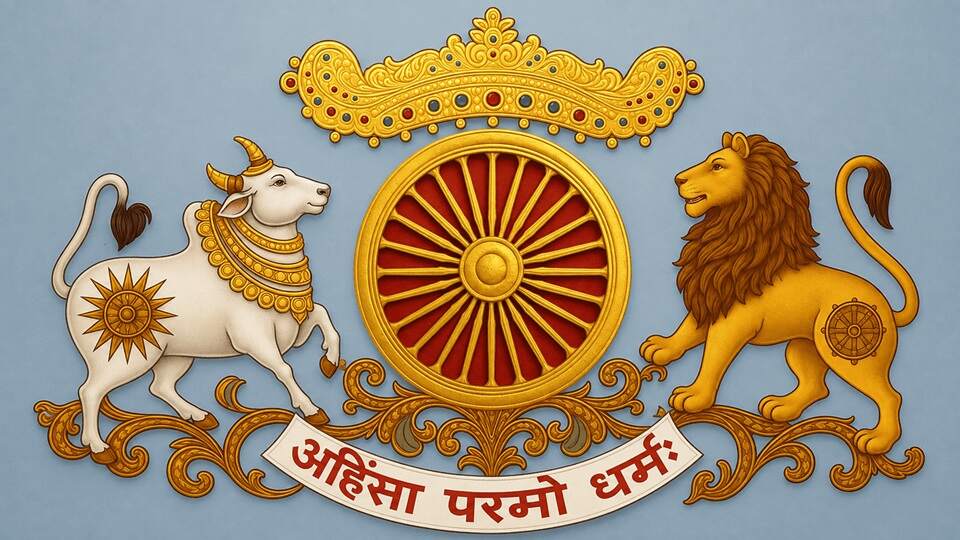
1: The Natural Order and the Universal Principle of Non-Violence
If we observe our dynamic universe or existential surroundings, we find that this entire system operates strictly in accordance with various natural laws. We study these laws within the natural sciences, and from this knowledge, we arrive at the conclusion that true natural laws never involve violence; consequently, everything maintains its existence.
If we expand the scope of our observation to include living beings, we realize that, alongside all natural laws, a non-violent lifestyle serves as the foundation for a happier and more sustainable existence. When all living beings adhere to fundamental laws and support one another, this entire ecosystem will not only help us achieve success in life but will also aid in comprehending nature as a whole. In fact, our supportive nature and compassion toward other living beings distinguish us from inanimate matter and pave the way for our progress. Thus, non-violence appears to be an eternal and universal law.
2: "Ahimsa Paramo Dharmah" and the Two Ancient Streams
This is the reason why the famous maxim "Ahimsa Paramo Dharmah"—which literally translates to "Non-violence is the supreme virtue or duty"—has been repeatedly referenced throughout Indian civilization. To comprehend the meaning of life or to answer the foundational questions of existence, history reveals two ancient streams that uphold this principle: Jainism (the Shramana tradition) and Hinduism (the Vedic or Brahmanical tradition).
The origins of both traditions extend far beyond recorded history. Modern scientific knowledge regarding the cosmos and astronomy remains insufficient to fully grasp the timelines established by these faiths. For instance, both traditions agree that Shri Rama was a realistic, monumental historical figure who lived roughly one million years ago, a fact not yet recognized by mainstream historical paradigms.
"Ahimsa Paramo Dharmah" is the singular eternal truth, and Jainism and Hinduism represent two pathways observing this same reality. Lord Rishabhdev (also known as Adinath), the first Tirthankara of Jainism, is referenced across the Vedas, Puranas, and numerous Jain texts; both traditions acknowledge that he existed long before Shri Rama. (According to Jain tradition, Shri Rama was the eighth Balabhadra, born after the liberation of the twentieth Tirthankara, Munisuvratnath, and attained liberation under his spiritual lineage).
3: One Truth, Two Philosophical Perspectives
In Jainism, the first Tirthankara, Lord Rishabhdev, is revered as the primal pioneer (Adi Purusha) or the first Kshatriya, who established the societal framework of Karmabhoomi for this cosmic era, inaugurated Indian civilization and culture, and founded the Ikshvaku dynasty. The nation was named 'Bharat' after his eldest son, Emperor Chakravarti Bharat, a fact documented in the scriptures of both religions.
The divergent interpretations of the eternal truth "Ahimsa Paramo Dharmah" stem from their roots: one tradition flows directly from Tirthankaras—omniscient beings (Sarvajna) who provided an absolute and precise exposition. The other tradition, guided by sages assisted by celestial beings, viewed monumental figures across eras as incarnations (Avatars) of a single supreme entity, God.
Consequently, Hinduism regards God as the creator of the universe and an entity that incarnates. Jainism, conversely, recognizes God as omniscient and infinite in potential, but not as the creator of the cosmos. Grounded in the law of Karma, Jain philosophy asserts that infinite, eternal souls can transcend the cycle of birth and death to attain absolute liberation (Moksha) and realize their own divinity through the threefold path of Right Faith, Right Knowledge, and Right Conduct.
4: The Profound Meaning and Reality of the 'Ultimate' Law
In the statement "Ahimsa Paramo Dharmah", the emphasis lies on the word 'Paramo' or 'Param', which signifies the Absolute—unconditioned and independent of any relative circumstance. The phrase establishes non-violence as the supreme, unalterable law governing the cosmos. Jainism characterizes this as a complete science that delineates the operations and principles of all existential reality.
The meaning of non-violence is far deeper than mere physical non-harm. Furthermore, Jain doctrine obligates householders to defend their nation, society, and faith with strength, even if it requires confronting and slaying adversaries in defense. Thus, Ahimsa is never an endorsement of cowardice or passivity.
5: The Scientific Foundation of Ahimsa: Six Fundamental Entities
The universal principle of non-violence is rooted in a realistic framework that explains cosmic structure. According to this philosophy, the universe is uncreated and comprises six eternal, uncreated substances (Dravyas):
- Akasha (Space): Provides accommodation to all substances.
- Kala (Time): The catalyst for transformation and continuity.
- Pudgala (Matter and Energy): Characterized by form, taste, smell, color, and touch.
- Jiva (Soul/Consciousness): Possesses awareness, perception, and sentience.
- Dharma (Medium of Motion): Facilitates movement for souls and matter.
- Adharma (Medium of Rest): Facilitates stillness and stability.
Compared to this holistic worldview, modern science—which primarily investigates the physical realms of Space, Time, and Matter/Energy—remains incomplete. Relying solely on a partial physical understanding to resolve foundational existential questions, or denying the reality of the soul, deters humanity from comprehending absolute truth.
Therefore, "Ahimsa Paramo Dharmah" is not merely a moral maxim; it is an exact scientific and spiritual reality based on total existential knowledge. Only by comprehending this cosmic totality—specifically the clear distinction between the conscious Soul (Jiva) and unconscious Matter (Pudgala)—can true Ahimsa be integrated into daily living. This knowledge dismantles karmic bondage and guides the soul toward the eternal bliss of liberation. True knowledge remains the sole foundation of authentic non-violence.
Discussion
No comments yet. Be the first to start the discussion!