The Hidden Reality of Jain Population in India: Colonial Epistemology or Statistical Erasure?
1. The Statistical Paradox and the Equation of Actual Population
A profound statistical paradox exists between the official figures of the Indian Census and the institutional, archaeological, and economic presence of the Jain community on the ground. According to the 2011 Census, the official population of Jains in India is recorded at merely 44.51 lakh (approximately 4.5 million, or 0.4% of the country's total population). However, a close examination of historical, archaeological, and sociological evidence demonstrates that Jainism has not always been a micro-minority community in Indian history; rather, for a long historical period, it was a mainstream religion across a vast geographical expanse of the Indian subcontinent. Archaeological remains scattered across villages throughout India and thousands of living pilgrimage sites—including Siddhakshetras, Kalyanak Kshetras, and Atishay Kshetras—serve as direct evidence of this historical reach. Even today, the sheer number of magnificent Jain temples, Upashrayas, Sthanaks, Gurukuls, and charitable trusts operating across the country requires lakhs of active families merely for their daily management and maintenance. Furthermore, considering the substantial share of the Jain community in India's total direct tax collection, industrial and trade organizations, and philanthropic trusts, it appears mathematically and economically impossible that this entire apparatus is being sustained by only 45 lakh individuals.
This demographic discrepancy is corroborated by empirical data from the national survey conducted by the International School for Jain Studies (ISJS), which studied 4,075 respondents (representing 19,160 Jain family members) and 2,168 Jain youth in depth. The most critical finding of this survey is that Jains are under-enumerated by an average of 89% in the Indian Census compared to their actual numbers. The socio-economic indicators of the survey further clarify this paradox, showing that the average annual per capita income of the Jain community is Rs. 4.92 lakh, which is approximately 2.4 times higher than the national per capita GDP at the time (Rs. 2.04 lakh in March 2019). If a fair, transparent, and awareness-driven enumeration of all hidden or administratively misclassified Jain families across the country is conducted, the actual population of the Jain community could emerge at several times the current official figures—potentially between 2 and 4 crore (20 to 40 million).
Demographic & Economic Parameter | Official Census / National Standard | ISJS National Survey & Sociological Assessment | Statistical Implication |
|---|---|---|---|
Total Population Size | 44.51 lakh (0.4% of total population, Census 2011) | 89% average under-enumeration; actual estimate 2 to 4 crore | Merger of a massive population into majority data due to administrative coding and surname confusion. |
Use of Surname | Informal classification based on caste/surname | 28.8% use 'Jain' surname; 65.7% use traditional/caste surnames | Nearly two-thirds of the population not writing 'Jain' with their names is the primary cause of miscounting. |
1. Confusion of Surnames and Traditional Sub-Castes
The most prominent practical reason why a large section of the Jain community remains invisible in government statistics in India is that they do not use 'Jain' as their surname. Empirical survey data reveals that only 28.8% of respondents use 'Jain' as their surname, whereas 65.7% of Jains use their traditional gotra, caste, or regional surnames. Prominent among these are surnames such as Agrawal, Oswal, Porwal, Khandelwal, Singhvi, Shah, Shahbahadur, Doshi, Mehta, Patwa, Chaudhary, Rao, Shetty, Sarak, Nainar, Mudaliar, and Chettiar. During the Census, when government enumerators go door-to-door to collect data, they frequently hear the surname of the head of the household (for example, 'Agrawal', 'Shah', or 'Mehta') and automatically record the family under the Sanatan or Hindu category without even asking about their religion. If no aware family member is present at the time of enumeration, or if they do not specifically intervene to have 'Jain' recorded in the religion column, the entire family is added to the majority population figures.
2. Technical Lapses in Coding at the Digital and Administrative Levels
Enumerators appointed in rural and semi-urban areas often lack proper training regarding the subtle philosophical distinctions of religious minorities and their specific census coding. While filling out offline forms or uploading data into digital systems, technical and human errors frequently cause the entries of Jain families to merge with the code of the mainstream majority religion. Additionally, when members within the community record sub-sects such as Digambara, Shwetambara, Sthanakvasi, or Terapanth in the main religion column instead of 'Jain', it creates the risk of exclusion from the standard religion code during central data processing.
3. Socio-Occupational Co-existence and Administrative Neglect of Agricultural Communities
In northern, central, and western India—particularly in Uttar Pradesh, Madhya Pradesh, Rajasthan, and Gujarat—Jain and Vaishnava/Hindu communities have lived side by side at the same socio-economic strata for centuries. Frequently, followers of both Jain and non-Jain (Hindu) traditions are partners within the same residential compound or the same joint business firm. According to ISJS data, 45.9% of Jain families still live in a joint family system today, although there is a growing trend toward nuclear families at 44.9%. Due to this close socio-commercial integration and a lack of administrative awareness, many families unknowingly fail to register their distinct 'Jain' religious identity in official documents and census forms. Similarly, it is a widespread misconception that Jains are limited solely to the urban mercantile class; in reality, the agricultural 'Sarak' community living in rural regions of Bihar, Jharkhand, West Bengal, Odisha, MP, and Chhattisgarh, as well as numerous farming and artisan castes residing in rural Karnataka, Tamil Nadu, and Maharashtra, strictly follow a pure Jain lifestyle (worship of Dev-Shastra-Guru, renunciation of night eating, and strict vegetarianism). However, in administrative records, they are classified under local castes or Other Backward Classes (OBC/other castes), as a result of which they are automatically counted within the Hindu community in the religion column of the census.
2. 'Nirvana Kanda' and Archaeological Evidence: The Expansive 'Shramanic Geography' of Ancient India
If a community constitutes a mere 0.4% of a country's population (as today's official census suggests), logically, its geographical footprint and architecture should be confined to a few select cities or regions. However, when we examine the geography, pilgrimage infrastructure, and architecture of ancient India, this colonial statistical framework collapses like a house of cards, making it unequivocally clear that for millennia, Jainism has been the mainstream popular religion of the entire Indian subcontinent.
'Nirvan Kand': The Ancient Spiritual Map of India
On the morning of Deepawali, when the 'Nirvan Ladoo' is offered in Jain temples across the country on the occasion of Bhagwan Mahavir's Moksha Kalyanak, the 'Nirvan Kand', composed in the Prakrit language, is recited. If analyzed from a historical and geographical perspective, it is not merely a devotional hymn, but an incredibly detailed geographical and spiritual map of ancient India, underscoring the unbroken presence of Jain pilgrimage sites across the entire subcontinent:
- North and Himalayan Region: From Ashtapad in the Himalayas (Mount Kailash - the Nirvana site of the first Tirthankar, Bhagwan Rishabhdev) to the Jambuswami garden in Mathurapur.
- Eastern India: From Sammed Shikharji on the Parasnath Hills in Jharkhand (the Nirvana site of twenty Tirthankaras) to Champapur (the Nirvana site of Bhagwan Vasupujya) and Pawapuri (the Nirvana site of Bhagwan Mahavir) in Bihar.
- Western India: From the Girnar mountains in Saurashtra, Gujarat (the Nirvana site of Bhagwan Neminath) to Tarvar Nagar (Taranga Ji) and Shatrunjayagiri in Palitana.
- Central and Southern India: From Gajpanth and Tungi-giri (Mangi-Tungi) near Nashik, Sonagiri near Datia, Siddhawarkoot on the banks of the Narmada (Rewa), to Kunthugiri, Kotishila in Maharashtra, and Muktagiri (Medhgiri) in the Satpura range.
Additionally, countless Siddha Kshetras (sites of salvation) such as Pawagiri (Oontgiri/Chulgiri), Reshandigiri (Nainagiri), Bawangaja (Barwani), Dronagiri, and Damoh's 'Kundalpur'—described in the ancient Agam text Tilloyapannati (Trilokaprajnapti)—serve as irrefutable proof that the Shramana culture permeated every inch of the Indian subcontinent, from where innumerable Jain monks attained liberation (Moksha). This list is merely a representative glimpse; in reality, thousands of such vibrant Siddha and Atishaya Kshetras across India remain centers of deep reverence even today.
Kalyanak Kshetras: The Civilizational Power Centers of Ancient India
To comprehend the vastness of this Shramana geography, one must look at the major political and cultural metropolises of ancient India—which are revered as 'Kalyanak Kshetras' in the Jain tradition. Metropolises like Ayodhya, Shravasti, Shauripur, Kaushambi, Kakandi, Kampil Ji, Prayagraj, Varanasi (Banaras), Sarnath (Singhpur), Ahichchhatra, Hastinapur, Rajgir, Mithila, and Vaishali were the greatest power centers of ancient Indian civilization, and all these cities have been the sacred lands of the Garbha (conception), Janma (birth), Tapa (penance), and Kevalgyan (omniscience) Kalyanaks of the Jain Tirthankaras. Historical centers like Bijolia in Rajasthan (the Parshvanath inscription site) are also an integral part of this unbroken civilizational chain.
History Carved in Stones (Archaeological Evidence)
History textbooks and census registers can be manipulated, but archaeological evidence buried underground or carved into mountain rocks never lies. Traveling in any direction in India, the most ancient and magnificent antiquities one encounters belong to the Jain Shramana tradition:
- The Golden Age of North and Central India: From Mathura's Kankali Tila (where hundreds of Kushan and pre-Kushan era Jain idols and Ayagapattas were found) to Chaurasi Ji; from the hundreds of ancient Jain temples at Lalitpur's Deogarh fort to the colossal Tirthankara idols carved into the rocks of Gwalior Fort, all reflect the unparalleled Jain splendor of Central India. This archaeological chain appears unbroken from the world-famous Jain temples of Khajuraho, Chawleshwar, Badagaon, Mahoba, Girargiri, Ahar Ji, Papoura Ji, Nougaja, Nawagarh, Thubon Ji, and Chanderi, all the way to Ramtek in Maharashtra. Specifically, the colossal stone idols of Bhagwan Shantinath and other Tirthankaras—dating back 1,000 years or more—found in the Udayagiri caves of Vidisha, Bahoriband, Samasgarh, Bhojpur, Churu, Bajrangarh, Banpur, Dudhai, Chandpur, Karitoran, and Sironj (Siron Ji) are living testimonies that this entire central Indian belt was an impenetrable bastion of Jain culture.
- Architecture of Eastern and Western India: In the east, the Udayagiri-Khandagiri caves of Odisha (dating to the 2nd-1st century BCE era of the Hathigumpha inscription by Kalinga Emperor Kharavela), Aggalayya Gutta, and Ambapuram; and in the west, Maharashtra's Ellora caves (Indra Sabha and Jagannath Sabha), Lohagad, Pale Caves, alongside the marble architecture of Gujarat and Rajasthan, bear witness to the golden age of Jain architecture.
- Archaeological Grandeur of South India: The archaeological expansion of Jainism in South India is astonishing. The Badami caves of Karnataka, Lakkundi, Aihole, Kambadahalli, the Jain temples of Hampi, Moodabidri (known as the 'Jain Kashi' with its 1,000-pillared Tribhuvana Tilaka Chudamani Basadi), and the world-famous 57-foot-tall monolithic Gommateshwara Bahubali statue at Shravanabelagola are its most magnificent examples. In Tamil Nadu, the Sittanavasal caves, the 16-foot-tall Bhagwan Neminath idol at Tirumalai, the rock-cut Jain beds and inscriptions at Kalugumalai, and Kanchipuram's 'Jina Kanchi' (Tiruparuttikundram), along with over 450 ancient Jain sites documented by the French Institute of Pondicherry, proclaim that the very foundation of South Indian literature and culture was laid by Jain monks (Samanars/Nayanars). Furthermore, the historic Sulthan Bathery (Kidanganad) Basti in Wayanad, Kerala, the Jainimedu temple in Palakkad, and the ancient Kallil Caves in Ernakulam prove the extensive reach of the Shramana tradition all the way to the deep south-western coast.
In essence, this scripturally verified, uniform, and millennia-old living pilgrimage network stretching from the Himalayas to the deep South is unparalleled in world history, proving that Jainism has been the core and pervasive cultural consciousness of this subcontinent.
3. Colonial Epistemology and Systematic Transfer of Identity Through the Census
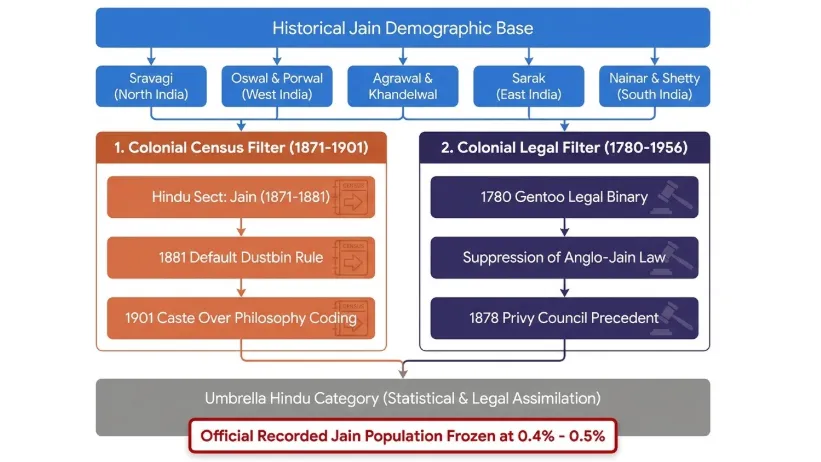
The transfer of a massive proportion of the Jain population into the majority Hindu identity is not an accidental occurrence; its roots lie in the 'Colonial Epistemology' and politics of classification of the 19th-century British colonial administration. In academic scholarship, this process has been analyzed under the frameworks of the "Colonial Construction of Religion" and "Census and Identity Manipulation". Renowned historian and anthropologist Bernard S. Cohn, in his seminal work "Colonialism and Its Forms of Knowledge: The British in India" (1996), demonstrated that British rule in India was sustained not merely by military or economic might, but was fundamentally a cultural project of control. According to Cohn, in order to govern and control the vast, complex, and fluid social world of India, the British devised "investigative modalities"—such as surveys, enumeration (censuses), historiography, and museology. Research by Prof. Brian K. Smith and Bernard Cohn clarifies that British administrators found the pluralistic complexities of Indian society administratively inconvenient. Consequently, under their policy of "Collection and Classification," rather than recognizing independent Shramanic and non-Vedic traditions like Jainism, Buddhism, and Sikhism as autonomous entities, they forcibly compressed them beneath a single overarching "Hindu" umbrella identity to simplify population management and governance.
Confusion of Early Orientalists and the 'Hindu Sect: Jain' Classification (1871–1881)
Until the mid-19th century, a deep misconception prevailed among British Orientalists and administrators that Jainism was not an independent religion, but rather either an early offshoot of Buddhism or a sect within Hinduism akin to the Vaishnavas. As a result of this flawed understanding, when formal all-India censuses commenced in 1871–72 (under Lord Mayo) and 1881, Jains in several provinces were not enumerated as a separate religious category but were recorded under "Hindu Sect: Jain". Although renowned German Orientalists Hermann Jacobi and Georg Bühler translated original Jain Agamas and ancient texts in the 1880s—irrefutably proving before the European academic world that Jainism is an ancient, independent Shramanic tradition completely distinct from both Buddhism and the Vedic tradition—by that time, the census architecture and classification apparatus of the British bureaucracy had already become entrenched.
The 'Default Category Rule' of the 1881 Census
In the 1881 Census report, British officials themselves admitted that for them, the term 'Hindu' was not a clearly defined religious category, but functioned like an administrative residual or 'dustbin' category. The official 1881 Census report explicitly stated the rule that every native who was unable to clearly define their sect or faith, or who identified themselves by any local or traditional name other than a recognized major religion, was automatically recorded under the 'Hindu' category. Because of this single administrative directive, lakhs of Jains—who identified themselves by sectarian names, gotras, Vaishya, Oswal, or 'Shravak/Sravagi'—were directly transferred into the Hindu population statistics within government systems.
The 1901 Census of Herbert Hope Risley and E. A. Gait: Prioritizing 'Caste' Over Philosophy
The 1901 Census, led by Census Commissioner Sir Herbert Hope Risley and his key collaborator Edward Albert Gait (E. A. Gait), placed anthropometry and rigid caste hierarchy at the center of classifying Indian society. In this census, which enumerated over 294 million people, Risley drew up a 'Code of Census Procedure' for provincial superintendents. Prior to the colonial era, social identity in India rested more on clan (Kula), caste (Jati), and conduct rather than a modern, rigid religious box. Prof. John E. Cort of the University of Michigan, in his famous research paper "Jains, Caste and Hierarchy in Western India", revealed how the British censuses of 1881 and 1901 destroyed the flexible social fabric of western India.
Risley and Gait admitted in great detail in the 1901 Census of India report that distinguishing Jains from Hindus on the ground was a nightmare for their poorly trained enumerators. Risley noted in his report that within the Oswal and Agrawal communities of Rajputana (Rajasthan) and Gujarat, religious boundaries were so fluid that within the same family, a father might call himself a Jain while his son registered himself as a Vaishnava (Hindu). When enumerators went door-to-door, they ignored the individual's religious philosophy (Jain philosophy) and asked only for their occupational caste (such as Marwari, Oswal, Porwal, Shrimal, Agrawal, or Maheshwari). Because rural and semi-urban enumerators were neither educated nor trained enough to comprehend philosophical distinctions, they collectively coded these entire mercantile groups as 'Hindu Vaishya'. As Dr. John Cort pointed out, when major merchant castes like the Oswals, Porwals, and Shrimals—who historically formed the backbone of Jainism—were coded merely as 'Hindu Vaishyas', the number of Jains shrank suddenly on paper, and Risley himself acknowledged that the recorded statistical number of Jains was far lower than the actual population adhering to Jain tenets.
Administrative Ignorance of the Term 'Sravagi'
In rural and semi-urban areas of northern and central India (particularly Uttar Pradesh, Madhya Pradesh, Haryana, and Bihar), the word 'Jain' was historically used very rarely in everyday parlance; instead, followers of Jainism traditionally referred to themselves as 'Sravagi', which is a vernacular corruption of the Prakrit and Sanskrit word 'Shravak' (Jain lay follower). Academic research published in journals by Jain Vishva Bharati (Ladnun) and the Bhogilal Leherchand Institute of Indology (Delhi), alongside official documents from the era of Cunningham and Risley, confirms that British census officials were completely unaware that 'Sravagi' meant Jain. Enumerators mistook 'Sravagi' for a local sub-caste of Hinduism and assigned them the 'Hindu' code instead of the Jain code. By the time the data was processed at the central level, this vast Sravagi population of northern India had officially become part of the Hindu population.
Census Period / Document | Key Administrative Policy & Classification Mechanism | Direct & Long-Term Impact on Jain Demographics |
|---|---|---|
1871–72 & 1881 Censuses | Due to Orientalist confusion, Jainism was not treated as an independent religion in many provinces and was listed under "Hindu Sect: Jain". | Initial administrative erosion of Jain sovereignty; flawed census framework established prior to Hermann Jacobi and Bühler's Agama translations (1880s). |
1881 'Default Category Rule' | Directive to automatically place every native unable to define their faith in standard European categories into the 'Hindu' category (administrative residual rule). | Millions of Jain families identifying by gotra, clan, or local sectarian names were directly transferred into Hindu statistics. |
1901 Census (H. H. Risley & E. A. Gait) | Under the 'Code of Census Procedure', 'Caste' and social hierarchy were prioritized over religious philosophy as the primary basis of enumeration. | Major Jain mercantile castes like Oswal, Porwal, Shrimal, and Agrawal were collectively coded as 'Hindu Vaishya'; enumerators coded 'Sravagi' (Shravak) as a Hindu sub-caste. |
1901 & 1911 (South & East India) | Farming and artisan castes integrated into the social fabric of local kingdoms were classified solely by social caste. | Near-total erasure of Tamil Nainar Jains, Karnataka's Shetty/Vokkaliga Jains, and eastern India's 'Sarak' Jains from official records; Chennai Jain population recorded as 0% in 1911 and 1941. |
4. Legal Assimilation: Suppression of Anglo-Jain Law and the Colonial & Constitutional Imposition of Hindu Law
The machinery that gave permanent and institutional form to the statistical manipulation of the census was the judiciary and the process of Legal Codification in British India. Distinguished scholar Prof. Padmanabh Jaini of the University of California, Berkeley, in his famous book "The Jaina Path of Purification" and his research papers, has extensively analyzed this historical tragedy of how an independent 'Anglo-Jain Law' was never allowed to develop during British rule, and Jain traditions were suppressed under 'Anglo-Hindu Law'.
1. The 1780 Binary Legal Division and the 'Gentoo Code'
To control the administration of justice in India, the British East India Company, under Warren Hastings, established a system through the 'Administration of Justice Regulation' of April 11, 1780 (Section 27) and the Regulating Act of 1780, mandating that in all civil matters related to inheritance, marriage, caste, and religious institutions, the laws of the Quran would apply to Muslims and the laws of the Shastras to the 'Gentoos' (i.e., Hindus). This was based on "A Code of Gentoo Laws" published by N. B. Halhed in 1776 (an English translation from the Persian of Vivadarnava Setu) and "The Digest of Hindu Law on Contracts and Successions" compiled by Sir William Jones and Henry Colebrooke (1797 - based on Vivada Bhangarnava). Since the British divided the Indian population into only two legal categories—'Muslim' (Anglo-Muhammadan Law) and 'Hindu/Gentoo' (Anglo-Hindu Law)—Jain, Buddhist, and Sikh communities, being non-Muslim and non-Christian, were bound within the purview of 'Hindu Law' without any scriptural basis.
2. The Privy Council's 'Legal Fiction': Chotay Lall v. Chunnoo Lall (1878)
The philosophical and social customs of the Jain community were fundamentally different from Vedic Dharmashastras (like Manusmriti, Mitakshara, or Dayabhaga). For example, in Jainism, marriage is not considered a religious sacrament for the liberation of the soul, nor does Jain philosophy prescribe any rituals like 'Pind Daan' or 'Shraddha' for the salvation of departed ancestors. Therefore, in the Jain tradition, the purpose of adoption was not for improving the afterlife or offering oblations (Shraddha Tarpan), but was entirely secular and linked to property inheritance; and according to Jain custom, a widow possessed absolute power of disposal over her deceased husband's property. Additionally, independent rules of property division existed in ancient Jain legal texts, according to which, after the death of the parents, all brothers would divide the ancestral property equally among themselves, but during the father's lifetime, the distribution of property depended entirely on the father's will.
However, in 1878, the Judicial Committee of the Privy Council, in the historic case of Chotay Lall v. Chunnoo Lall (1878 ILR 4 Cal 744 / 6 IA 15 PC), established a 'Hindu Legal Fiction' that struck a deep blow to the independent Jain identity. The Privy Council ruled that although the origin and philosophy of Jainism might be different, until a Jain litigant proves a specific and unbroken ancient custom (Special Custom) in court with strict evidence, the ordinary Hindu law (Mitakshara or Bengal School) would apply to them.
This judicial decision caused an unjust shifting of the burden of proof (Onus of Proof). As clarified in judicial analyses, logically, the courts should have looked at what the Jain legal texts state, and the burden of proof should have been on the person claiming that a Jain family had abandoned its original Jain law and adopted Hindu law. However, the Privy Council reversed this legal principle, compelling Jain families in every case to prove that their custom differed from the Mitakshara. The long-term sociological consequence of this was that among the mercantile families of Rajasthan, Gujarat, and Uttar Pradesh—where business and matrimonial relations took place between some Jain and Vaishnava families during the era of the Sanatani integration movements, and when British courts consistently applied a single 'Anglo-Hindu Law' in matters of property division, inheritance, and joint family (Joint Hindu Family / Coparcenary)—the distinction that their fundamental philosophy was Jain gradually faded from the collective consciousness of the families after a few generations. The legal compulsion to be registered as a 'Hindu Undivided Family' (HUF) in property and inheritance documents officially and practically assimilated tens of millions of Jain descendants into the Hindu identity.
3. Contradictions of Colonial Acts and High Courts (1865–1947)
This legal anomaly persisted continuously in the legislative acts of the British era. Despite no separate mention of Jains in Section 331 of the Indian Succession Act, 1865, the courts interpreted that the word 'Hindu' automatically included Jains. In 1927, the Madras High Court in Gateppa v. Eramma (1927) and in 1939, the Bombay High Court in Hirachand Gangji (1939), explicitly acknowledged that Jainism and Buddhism are two completely independent and distinct religions in India, contrary to the Vedic religion. Despite this, when the 'Hindu Law of Inheritance Amendment Act, 1929' was passed—which did not separately mention Sikhs, Buddhists, and Jains—the Bombay High Court in the case of Ambabai / Ambalal v. Keshav Bandochand Gujar (ILR 1941 Bom 250) ruled again that being governed by Mitakshara (as amended by Mayukha), Jains would also fall under this Hindu Act.
4. Constitutional and Statutory Status in Independent India and the 'Bal Patil' Case
Even after independence, this colonial legal framework did not end; rather, it was institutionalized in modern codes. Although Explanation II of Article 25(2)(b) of the Indian Constitution mentioned the Jain religion as an independent entity separate from Hinduism (as the court highlighted in the Pannalal v. Sitabai case that the framers of the Constitution mentioned Jains separately precisely considering the fundamental differences between the two religions), Sikhs, Buddhists, and Jains were kept within the 'Hindu' context for the purposes of social reform and religious institutions. Immediately after this, by passing the Hindu Succession Act, 1956 (Section 2 and Section 6), the Hindu Marriage Act, 1955, the Hindu Adoptions and Maintenance Act, 1956, and the Hindu Minority and Guardianship Act, 1956, the Jain community was completely subjugated to Hindu Personal Law and the Mitakshara Coparcenary system.
Although the Supreme Court acknowledged the distinctiveness of Jainism in the case of Commissioner of Wealth Tax, West Bengal v. Smt. Champa Kumari Singhi (AIR 1968), and in 1993, the National Commission for Minorities (NCM) recommended notifying the Jain community as an independent religious minority community based on constitutional provisions and judicial precedents, the legal entanglement remained. When eminent Jain scholar and activist Bal Patil (1932–2011) filed a petition in the Supreme Court to have Jains declared a national minority under Section 2(c) of the National Commission for Minorities Act, 1992, a three-judge bench on August 8, 2005 (Chief Justice R.C. Lahoti, Justice D.M. Dharmadhikari, and Justice P.K. Balasubramanyan) in Bal Patil & Anr. v. Union of India (2005), citing the 11-judge bench T.M.A. Pai Foundation case, ruled that the determination of minority status should be done by state governments based on the state-level unit. However, the extra-judicial comments (Obiter Dicta) made by Justice Dharmadhikari in Paragraph 7 and related sections of this judgment—which described Jainism as a "reformist movement" within Hindu philosophy, akin to Brahmo Samaj, Arya Samaj, and Lingayats, and called Sikhs and Jains a "part of the wider Hindu community"—sparked a deep constitutional and historical controversy. Bal Patil also registered an objection with the Press Council of India regarding a similar article by former Solicitor General Soli Sorabjee, upon which Sorabjee had to express regret, while numerous jurists, including Dr. L.M. Singhvi and Bal Patil, described these extra-judicial remarks of the Supreme Court as historically baseless.
This judicial contradiction was resolved just a year later in 2006 in the historic judgment of U.P. Basic Shiksha Parishad (2006), in which the Supreme Court explicitly ruled that "Jain Religion is indisputably not a part of Hindu Religion". Despite this, the impact of the colonial legal mindset ran so deep that attempts were made to club Jainism and Buddhism back under the definition of Hinduism in laws like the Freedom of Religion Bill passed by the Gujarat Legislative Assembly in 2006–2007, which was later returned by the Governor due to constitutional objections.
Year / Period | Legal Enactment / Judicial Precedent | Core Legal Principle & Ruling | Impact on Independent Jain Identity |
|---|---|---|---|
1776 – 1797 | Gentoo Code (Halhed), 1780 Regulation & Colebrooke's Digest | Division of personal law into only two binary categories: 'Mohamedans' (Muslims) and 'Gentoos' (Hindus). | Prevented the emergence and development of an independent 'Anglo-Jain Law' from the outset. |
1878 / 1879 | Chotay Lall v. Chunnoo Lall (Privy Council, ILR 4 Cal 744) | Established the 'legal fiction' that ordinary Hindu law (Mitakshara/Bengal school) automatically applies to Jains unless a special custom is proven. | Shifted the burden of proof onto Jains; legally assimilated Jain families into the Vaishnava/Hindu framework through property and inheritance. |
1927 & 1939 | Gateppa (Madras HC) & Hirachand Gangji (Bombay HC) | High Courts recognized that Jainism and Buddhism are two distinct, ancient religions in India in contrast with the Vedic religion. | Judicial affirmation of philosophical independence, yet Hindu enactments continued to govern property law. |
1941 | Ambabai v. Keshav Bandochand Gujar (ILR 1941 Bom 250) | Held that Jains were governed by the Hindu Law of Inheritance (Amendment) Act, 1929 despite no separate mention of Jains. | Reinforced the colonial legislative convention of treating Jains as included under the term 'Hindu' by default |
1955 – 1956 | Hindu Succession Act (Sections 2 & 6) & Hindu Code Bills | Codified Jains under Hindu personal law and Mitakshara coparcenary following Article 25 (Explanation II) of the Constitution. | Complete absence of an independent Jain Personal Law; bound Jains to Hindu categories in HUF and succession records. |
2005 vs. 2006 | Bal Patil v. Union of India (2005) vs. U.P. Basic Shiksha Parishad (2006) | 2005 obiter dicta called Jainism a Hindu reform movement; 2006 Supreme Court ruling held that Jainism is indisputably not a part of Hindu religion. | Constitutional ambiguity led to state-level attempts (such as the 2006 Gujarat bill) to club Jains under Hinduism. |
5. The Jain Community Spread Across All Four Varnas and 217+ Castes: Debunking the Myth of a 'Vaishya-Only Religion'
Due to colonial classification, a deep-rooted misconception has prevailed in the general public and mainstream discourse that Jainism is solely the religion of Marwaris, Gujaratis, and Baniyas (Vaishyas), and that its followers are confined only to the affluent merchant class. However, from ancient times through the colonial era and even today, people from all four Varnas of Indian society (Brahmin, Kshatriya/Peasant, Vaishya, and Shudra/Artisan) as well as hundreds of castes within tribal communities have been mainstream followers of Jainism.
The in-depth ethnographic and sociological research conducted by Professor Pradip Phalataṇe, Director of the 'Institute for Jain Social Studies, Pune' (documented in the articles of Prof. Phalataṇe's research work 'Jain Samaj: Ek Khoj'), has so far established the detailed identification of 217 Jain castes among the indigenous populations of various Indian states. This research irrefutably proves that Jainism is not a sect of any single Varna or province, but has been a mass religion spread across all social classes at the pan-India level:
1. Jain Castes of Peasant and Kshatriya Origin (Largest in Number)
Professor Pradip Phalataṇe's research reveals that in terms of actual numerical strength, the largest number of Jain followers in India are farmers (peasants)—not merchants. These peasant Jain castes exist in massive numbers in several states including West Bengal, Bihar, Madhya Pradesh, Karnataka, Maharashtra, Tamil Nadu, Punjab, Haryana, and Gujarat.
- Major Peasant Castes: Among these, castes like Chaturth (the prominent peasant Jains of Maharashtra and Karnataka), Sarak (Eastern India), and Jain Jats (Punjab, Haryana, and Western Uttar Pradesh) are highly prominent.
- Kurmi Farmers of Damoh and the Tradition of Great Acharyas: In the Damoh district of Madhya Pradesh and the surrounding Bundelkhand region alone, approximately two hundred thousand Kurmi farmers are followers of Jainism. It is particularly noteworthy that two of the greatest saints of the modern Jain community—Acharya Shri Vidyasagar Ji Maharaj of the Digambar tradition and Acharya Shri Vijay Indradinnasuri Ji Maharaj of the Shwetambar tradition—hail from this very peasant family background.
2. Jain Castes Associated with Artisans, Craftsmen, and Specialized Professions
Alongside peasants, there are countless castes across the country that have been associated with traditional crafts, artisanship, or specific rural-urban professions, and have been practicing Jainism for generations:
- Kasar / Kasak: This Jain community, involved in making bangles and metal utensils, is widely spread across Maharashtra (especially in Pune and rural areas).
- Kalar: This community was formerly associated with the liquor-brewing profession, but upon adopting the Jain principles of non-violence and ethical conduct, they completely abandoned that trade. This Jain community is found in large numbers in Eastern Maharashtra (Vidarbha), Southern Madhya Pradesh, and Odisha.
- Saitwal: Traditionally engaged in tailoring and agriculture, this community is currently one of the most organized and aware Jain castes in Maharashtra.
- Bhavsar: A Jain caste associated with the profession of dyeing clothes and tailoring.
- Other Artisan and Service-Oriented Castes: In addition to these, a large number of Jain followers exist among Weavers, Potters (Kumhar), Carpenters (Sutar), Barbers (Nai), and Herders (Sadgop).
3. The 15 Castes of Jain Brahmins
Distinct from Vedic Brahmins, there are 15 independent castes of Brahmins within the Jain tradition—associated with temple rituals, temple management, astrology, and scriptural study—who are followers of Jainism. According to Prof. Phalataṇe's research, the prominent castes among these include Jain Brahmin, Bhojak, Gaud, Tapodhan, Raval, Upadhye, and Indra (priests of Jinalayas in South India and Maharashtra).
4. Jain Followers Among Tribal and Marginalized (Dalit) Communities
The greatest testament to the Shramana egalitarianism of Jainism is that even among the major tribal communities of India, sub-castes following Jainism have existed since ancient times. According to research, independent Jain-following sub-castes are found within tribal communities like Meena, Kurumba, Santhal, and Bhil, who practice non-violence and worship Jain family deities (Kuladevatas). Similarly, two castes in Madhya Pradesh named Dharmapal and Veerwal Nayak, who were formerly considered untouchables within Hindu society, embraced Jainism to achieve comprehensive social, educational, and economic upliftment, and today they are prominent and respected components of the Jain community in Madhya Pradesh.
5. The Sociological Reason for Institutional Narrowness and Distance from the Mainstream
It is a crucial question: when tens of millions of people from over 217 castes in India are connected to the Jain tradition, why did they remain invisible from the so-called 'mainstream' of society?
- Mercantile Dominance: According to Professor Pradip Phalataṇe's analysis, what is called the mainstream today has actually been reduced to the current of a few urban mercantile classes confined within the boundaries of their caste and sect. The so-called 'All-India' Jain institutions and organizations have long been dominated by people from only two or three major Baniya castes and a few select provinces. Consequently, non-Vaishya, peasant, artisan, and rural Jain communities could not get adequate representation on national platforms.
- Impact of the Census: Furthermore, the caste-based classification of the colonial census directly placed all these peasant and artisan Jain castes into the 'Hindu' category.
- Current Situation: However, at present, this vast, multi-caste Jain society is organizing itself at the national level and is re-establishing its original Shramana identity.
6. The Geography of Regional Erasure: The Invisible Jain Communities of Eastern and Southern India
The most severe blow of the colonial census and administrative policies fell upon the indigenous and rural Jain communities of Eastern and Southern India, who were engaged in agriculture, weaving, or local professions far removed from urban mercantile networks.
1. The 'Sarak' (Shravak) Community of Eastern India
Residing in Eastern India—specifically the Rarh region of West Bengal (Purulia, Bankura, Simlapal), Jharkhand, Bihar, Odisha, and Chhattisgarh—the 'Sarak' community is a living yet statistically neglected pillar of the ancient Shramana tradition. Linguistically and historically, the word 'Sarak' is the eastern regional distortion of the Sanskrit word 'Shravak' (a Jain lay follower).
-
Historical Legacy: The ancient Jain temples, caves, and idols of Tirthankaras scattered across this entire region, including Pakbirra in Purulia, bear witness to their historical prosperity, where cultural renaissance efforts have also been made by Acharya Shantisagar Ji and various Digambar Jain Sanghas in modern times.
-
Religious Devotion and Conduct: Culturally and religiously, despite living in the meat-dominant environment of Eastern India, the Sarak community has preserved the strict Jain conduct of non-violent vegetarianism and abstinence from night eating (Ratri Bhojan Tyag) for centuries, which is an extraordinary cultural phenomenon in that geographical area. The Sarak community regards the Jain Tirthankaras, and especially the twenty-third Tirthankara, Lord Parshvanatha, as their principal deity, and devoutly chants the Navkar Mantra.
-
Neglect in the Census: Since the British era, census officials cataloged this vast, agriculture-dependent population as local Hindus or Other Backward Classes (OBC) instead of recording their independent Jain philosophy. As a result, despite numbering in the hundreds of thousands, the Sarak Jains continue to be counted under the Hindu population in the official census.
2. The Tamil Jains (Samanar / Nayanar) of South India and the Peasant Communities of the Deccan
The history of Jainism in South India is continuously attested from at least the 4th to 3rd century BCE (evidenced by the arrival of Jain ascetics in Tamil Nadu from Shravanabelagola in Karnataka and the Tamil-Brahmi inscriptions of Mangulam). The very foundation of the golden age of Tamil literature—the Sangam and post-Sangam periods—was laid by Tamil Jain monks and scholars (known in Tamil as 'Samanar' / Samaṇar).
- Literary Contribution: The oldest Tamil grammar text Tolkāppiyam and the 13th-century Naṉṉūl (by Pavanandi Munivar), the ethical code Tirukkural (which strongly advocates non-violence and vegetarianism in Chapter 26 and Verse 259) and Nālaṭiyār, as well as three of the five great Tamil epics—Silappatikaram (by Ilango Adigal, whose main characters Kannagi and Kovalan were Jains), Jivaka Chintamani, and Valayapathi—are the profound contributions of Digambar Jain Acharyas and poets.
- Historical Evidence: According to George L. Hart, the permanent 'Jain Sangha' established in Madurai in 604 CE was the primary model for the later Tamil Sangam tradition. The French Institute of Pondicherry has documented approximately 450 ancient Jain archaeological sites in Tamil Nadu, and the 16-foot-tall idol of Bhagwan Neminath from the 12th century at Tirumalai near Tiruvannamalai still stands as a symbol of this heritage.
Demographic Decline: Despite such a vast historical and literary legacy, only a minuscule fraction of the Jain population has been recorded in the official census data of Tamil Nadu:
- 1951: 22,165 (0.07%)
- 1961: 28,350 (0.08%)
- 1991: 66,900 (0.12%)
- 2001: 83,359 (0.13%)
- 2011: A mere 89,265 (0.12%) out of the state's total population of 72,147,030.
Even within this figure of 83,359 to 89,265, the majority consists of Shwetambar and Digambar Jains who migrated from North and West India (Rajasthan and Gujarat), while the estimated population of the indigenous Tamil Digambar Jains has shrunk to merely 25,000 to 35,000 (concentrated primarily in the villages around Tiruvannamalai, Kanchipuram, Vellore, Viluppuram, Ranipet, Kallakurichi, Thanjavur, and the Mel Sithamur Math).
Occupational and Educational Status: An analysis of the Tamil Nadu census (base population 83,359: 43,114 males and 40,245 females) reveals a literate population of 68,587. The total working population is 26,943 (non-workers 56,416), which includes:
- 2,216 Cultivators
- 768 Agricultural Workers
- 574 Household Industry Workers
- 23,385 Other Workers (teachers, public and private sector employees, etc.)
Causes of Statistical Contraction (Colonial Policies): The direct cause of the statistical contraction of this historic Jain population has been the methodology of the colonial and post-colonial census:
- Local Assimilation and Titles: Indigenous Tamil Jains use titles like 'Nainar' / 'Nayinar', 'Mudaliar', and 'Chettiar' as surnames. Although they follow Jain rituals (Ezhankappu, Karnavedha) and conduct (eating before sunset, pure vegetarianism), they are completely assimilated into the local Tamil society in terms of outward attire, language, and traditions like wearing the sacred thread (Janeu).
- Impact of Risley's Policy: Under Risley's caste-based classification policy in the 1901 and 1911 censuses, the rural peasant Jain families of Madurai and Northern Tamil Nadu were directly assigned the 'Hindu' code based on their titles.
- Shocking Data of Chennai: While Chennai recorded Jains as 0.05% in 1901, 0.2% in 1921, and 0.4% in 1931, the 1911 and 1941 censuses recorded the number of Jains in Chennai as 0% (zero). With growing awareness after independence, this proportion increased from 0.4% in 1951 to 1.11% in 2011.
- Situation in Other States: Similarly, in Karnataka (where a large section of the Vokkaliga and Shetty groups has historically practiced Jain conduct) and in the rural areas of Maharashtra (including the 'Kasak/Kasar' community of Pune), hundreds of thousands of people who worship the Dev-Shastra-Guru, practice abstinence from night eating, and adhere to non-violence continue to be recorded under backward or other local Hindu castes in administrative documents.
7. Conclusion and Strategic Roadmap for Demographic Rectification
The foregoing historical, archaeological, legal, and sociological analysis establishes that the stagnation of the Jain population between 0.4% and 0.5% of India's total population across every census from 1881 to 2011 is not a natural demographic rate; rather, it is the cumulative result of 150 years of colonial classification, the 'Default Hindu Rule', caste-based coding, and the legal fiction of 'Anglo-Hindu Law'. While the spiritual geography of the Nirvana Kanda, the network of Kalyanak Kshetras, and thousands of ancient archaeological sites from Mathura and Deogarh to Shravanabelagola and Kalugumalai attest to Jainism's pan-Indian mainstream heritage, Prof. Pradeep Phaltane's documentation of 217 Jain castes proves that Jain society is not restricted to a few Vaishya groups, but is deeply rooted across cultivators, artisans, Brahmins, and indigenous tribes. When British Census Commissioner Herbert Hope Risley and his predecessors themselves admitted in official reports that the statistical numbers of Jains appearing on paper were far below the actual population adhering to Jain tenets, and when modern empirical research (ISJS) demonstrates an 89% rate of under-enumeration, the necessity of rectifying this historical error becomes indisputable. This demographic awareness campaign is not motivated by political competition, but is essential to secure the rightful place of one of India's most ancient Shramanic cultures, its historical contributions, and its demographic truth within official government records.
In the context of upcoming censuses and policy reforms, the foremost requirement is to rise above sectarian and caste boundaries to ensure a standardized 'Jain' entry. In the religion column of the census form, every follower—whether belonging to the Digambara, Shwetambara, Sthanakvasi, or Terapanth tradition, and whether from a mercantile, agricultural, or artisan caste—must clearly record only 'Jain', as entering sub-sects or castes in the main religion column fragments or invalidates data coding. Alongside this, administrative redressal of surname-induced bias is indispensable; since 65.7% of Jain families use traditional and regional surnames such as Agrawal, Oswal, Porwal, Khandelwal, Shah, Mehta, Doshi, Shetty, Kasar, Saitwal, Chaturtha, Kurmi, or Nainar, census training manuals must incorporate mandatory instructions prohibiting enumerators from assuming religion based on surname or caste and requiring them to explicitly ask the respondent's religion before recording the entry.
At the rural and regional levels, dedicated census awareness and social integration campaigns must be conducted in 'Sarak' villages across Bihar, Jharkhand, West Bengal, and Odisha, among the Kurmi Jain farmers of Madhya Pradesh (Damoh), the Saitwal, Kasar, Kalar, Chaturtha, Dharmapal, and Virwal Nayak communities of Maharashtra and central India, and across the rural Jain belts of Tamil Nadu and Karnataka, enabling these communities to fearlessly record their ancestral 'Jain' identity in the religion column while retaining their socio-economic classifications (such as OBC, SC/ST, or agricultural categories). Finally, to permanently safeguard academic and legal sovereignty, the scholarly findings of Prof. Padmanabh Jaini, Dr. John E. Cort, Bernard Cohn, Prof. Pradeep Phaltane, and Indian research institutions (Jain Vishva Bharati, Bhogilal Leherchand Institute of Indology, and Institute for Jain Social Studies, Pune) should be disseminated in accessible Hindi, English, and regional languages across mainstream educational curricula (such as NCERT) and digital platforms, and in light of the Supreme Court's 2006 ruling ("Jain Religion is indisputably not a part of Hindu Religion"), the independent legal identity of Jain succession, adoption, and religious trusts should be accorded clear constitutional and statutory recognition.
Discussion
No comments yet. Be the first to start the discussion!