From China to Sivakasi: The Hidden History of Firecrackers on Diwali
1. The Illusion of Tradition: Are Firecrackers Really a Part of Ancient Diwali?
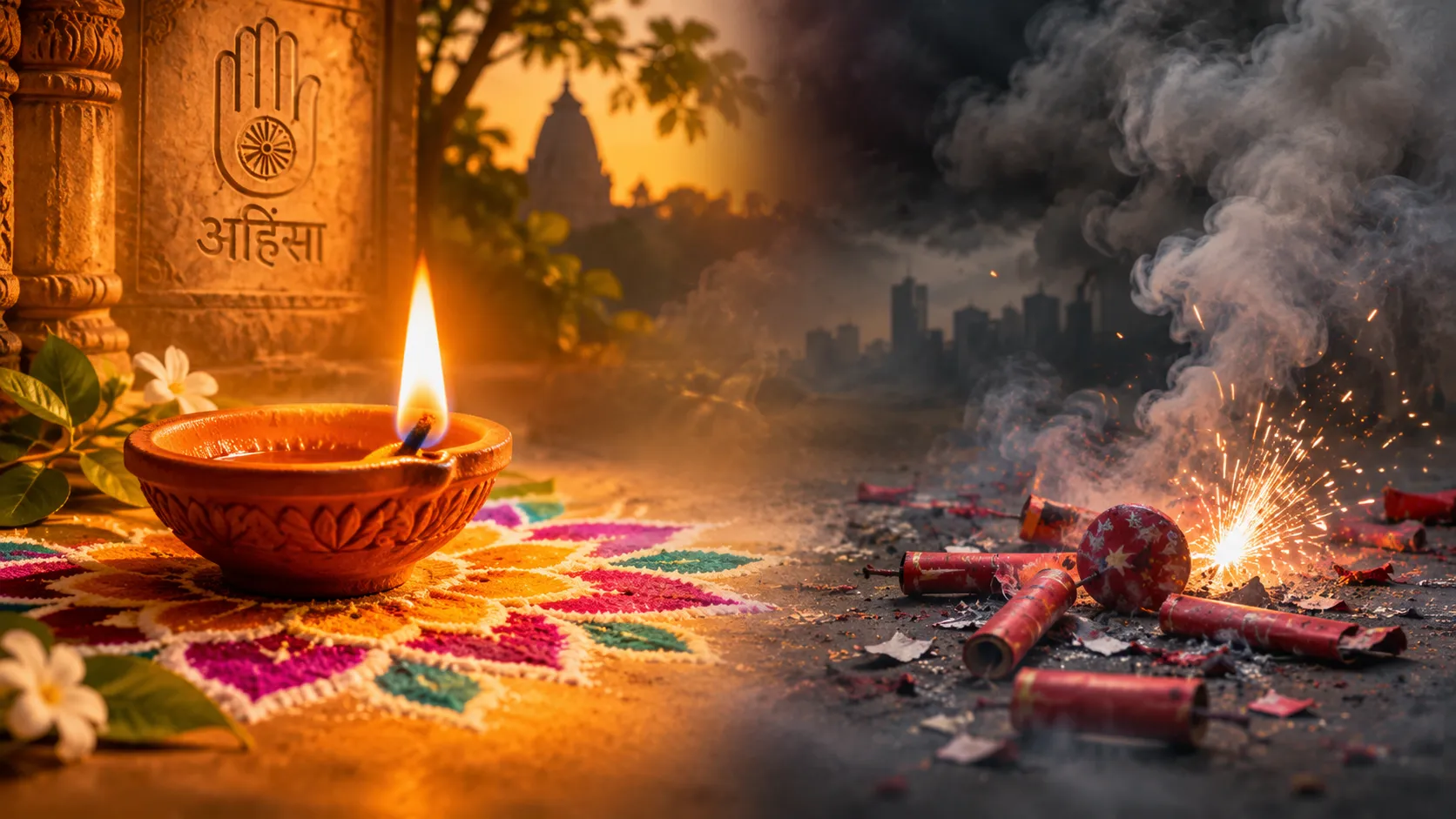
Today, the very mention of Deepawali instantly brings to mind the deafening noise and smoke of firecrackers. A vast majority of society has come to believe that bursting crackers is an ancient, unbroken religious tradition. Consequently, any appeal to restrict fireworks—whether on environmental or ethical grounds—is often met with aggressive defensiveness and viewed as an attack on religious identity. But does this belief hold any historical truth?
For millennia, Deepawali has been universally celebrated across the Indian subcontinent strictly as the Festival of Lights. In the Jain tradition, it is a day of profound spiritual significance, marking the Nirvana Kalyanak of Lord Mahavira, while in the wider Hindu tradition, it beautifully symbolizes the return of Lord Rama to Ayodhya. The original, authentic celebrations involved lighting earthen lamps (diyas), engaging in deep spiritual reflection (swadhyay), and practicing charity. If we examine ancient Indian scriptures, Jain Agamas, the Ramayana, or any historical text, there is absolutely no mention of gunpowder, explosives, or celebratory air pollution.
How, then, did a toxic, noisy, and violent chemical mixture become the defining symbol of an inherently peaceful and spiritual festival? The answer lies not in ancient spiritual wisdom, but in a brilliantly executed 20th-century commercial marketing strategy.
2. The Accidental Elixir: The Invention of Gunpowder in 9th Century China
To understand how firecrackers eventually hijacked Deepawali, we must first look at their true birthplace: China. The invention of gunpowder was not a planned scientific endeavor for festivals, nor was it initially meant for warfare. It was, in fact, a monumental accident. During the 9th century (under the Tang Dynasty), Chinese Taoist alchemists were obsessively experimenting with various minerals to concoct an "Elixir of Immortality" that would grant humans eternal life.
Instead of an elixir of life, their volatile mixture of saltpeter (potassium nitrate), sulfur, and charcoal resulted in a massive explosion. The Chinese aptly named this mysterious black powder 'Huo Yao' (meaning 'fire chemical').
Initially, there were no sparkling or colorful fireworks like we see today. The early Chinese simply packed this raw gunpowder into hollow bamboo shoots and threw them into the fire. The heat would cause the bamboo to explode with a loud bang, a device they called 'Baozhu' (exploding bamboo). The sole purpose of these loud explosions was rooted deeply in local folklore and superstition. It was believed that the deafening noise would scare away evil spirits and a mythical man-eating beast named 'Nian' during the Chinese Lunar New Year. Thus, the very origin of firecrackers was based on a Chinese superstition, completely completely disconnected from India, Deepawali, or any ancient spiritual tradition.
3. From Mughal Courts to British Imperial Displays: The Royal Journey of Fireworks
Long before European colonizers arrived, gunpowder made its way to India through Arab traders and Central Asian invaders between the 13th and 15th centuries. Early historical records, such as the accounts of the Persian ambassador Abdur Razzaq who visited the Vijayanagara Empire in 1443, mention the grandiose display of fireworks during royal festivals.
However, the true integration of fireworks into Indian celebrations began within the Mughal courts. What started as military artillery under Babur transformed into a grand spectacle of royal indulgence. Emperors like Akbar and Shah Jahan made fireworks an essential part of royal weddings and their celebration of Deepawali, which they referred to as Jashn-e-Chiraghan. Observing this, Rajput and Maratha rulers adopted the practice to showcase their own wealth, power, and status. It is crucial to note that during this entire period, fireworks remained strictly an elite luxury. The common Indian citizen had no access to gunpowder and continued to celebrate Deepawali in the traditional, peaceful manner with earthen lamps.
The British later elevated fireworks from a royal indulgence to a psychological tool of imperial dominance. Utilizing advancements in European chemistry, they introduced colored fireworks to India. The British Raj used massive, imported firework displays during events like the Delhi Durbar and royal birthdays to project British supremacy over the Indian masses. Furthermore, fearing a rebellion after the 1857 uprising, the British passed the Indian Explosives Act in 1884, severely restricting local gunpowder production. This legal move ensured that fireworks remained an expensive, imported luxury, completely cementing their status as a symbol of colonial power and aristocratic wealth, rather than any religious devotion.
4. Sivakasi's Industrial Boom: The Local Industry That Rewrote the Deepawali Market
If fireworks were an elite, expensive luxury until the British era, how did they reach the hands of the common Indian middle class and become synonymous with Deepawali? The transformation from a royal display to a household 'tradition' was not driven by religious awakening, but by the industrial rise of a dry, economically challenged town in Tamil Nadu called Sivakasi.
The story began around 1923 when P. Ayya Nadar and A. Shanmuga Nadar traveled to Calcutta to learn the art of making matchboxes. Returning to Sivakasi, they capitalized on the region's dry climate to develop a local matchbox industry. Over time, leveraging their experience with chemicals and production techniques, these local entrepreneurs and laborers ventured into fireworks manufacturing. The Second World War (1939–1945) played a crucial role in the expansion of this industry. The war disrupted international trade and halted the import of foreign fireworks, creating massive new opportunities for domestic production to meet local market demands.
In 1940, the Indian Explosives Rules were implemented, bringing the manufacture, storage, and sale of explosives under strict licensing and regulation. Operating within these frameworks, Sivakasi rapidly developed an interconnected, organized industrial network comprising matchboxes, fireworks, packaging, and eventually a robust printing industry.
With increased production capacity making fireworks more accessible than ever, the industry faced a new challenge: finding a pan-India market to consume their goods simultaneously. They targeted the Festival of Lights, Deepawali. To penetrate the Indian psyche, the Sivakasi manufacturers utilized their local printing ecosystem to execute a brilliant marketing masterstroke. They began printing captivating images of Hindu deities—Goddess Lakshmi, Lord Ganesha, and Lord Krishna—on the packaging of firecrackers.
When the common citizen saw 'Laxmi Bomb', 'Ganesh Anaar', or 'Krishna Charkhi' in the local markets, their subconscious mind slowly began to link these noisy chemical explosives with religious devotion. Post-independence, with rapid urbanization, expanded distribution networks, and increasing purchasing power, bursting crackers became an accessible status symbol to showcase one's wealth. Thus, a combination of wartime import restrictions, local entrepreneurship, and a clever marketing strategy successfully transformed the Deepawali market, convincing subsequent generations that the festival is incomplete without this commercial product.
5. The Philosophical Perspective: Ahimsa, Mahavir Nirvana, and the Compassion of Lord Rama
While the commercial world was busy selling noisy explosives wrapped in religious imagery, the true spiritual essence of Deepawali was gradually overshadowed. To reclaim this festival, we must look at it through the lens of ancient Indian philosophies, which universally preach compassion.
In the Jain tradition, Deepawali is celebrated as 'Veer Nirvana Utsav'. It marks the highly auspicious day when the 24th Tirthankara, Bhagwan Mahavira, attained Nirvana at Pavapuri, and his chief disciple, Gautam Swami, attained Keval Gyan (infinite knowledge). While many scholars and historians believe that the earliest recorded origins of Deepawali trace back to this very event of Mahavira's Nirvana, the festival is also widely celebrated in the Vedic tradition to mark the return of Lord Rama to Ayodhya.
Even if we look at this from the popular social tradition of Lord Rama’s return, the logic against firecrackers remains absolute. Lord Rama, revered as Maryada Purushottam, was the ultimate embodiment of Dharma and compassion towards all living beings. Would a benevolent king, who protected the weakest of creatures in the forest, ever approve of a celebration that chokes the air with toxic smoke, creates deafening noise, and causes mass ecological violence? Certainly not.
Whether we follow the Jain principle of 'Ahimsa Paramo Dharma' (non-violence is the highest duty) or the social ideals of Lord Rama's compassion, bursting firecrackers is an act of severe violence. This violence is not limited merely to the destruction of numberless microscopic organisms; it is a direct assault on five-sensed beings and the entire ecosystem. The deafening noise and toxic smoke from firecrackers prove fatal for newborns, asthma patients, and the elderly. For speechless animals and birds, it is nothing short of a terrible tragedy—loud explosions cause terrified birds to abandon their nests and leave stray animals severely traumatized. The catastrophic pollution of our air, soil, and water caused by gunpowder chemicals constitutes a massive act of violence against humanity and nature itself. The true philosophical message of Deepawali across all traditions is not to wage such a chemical war against nature but to engage in self-study, offer the gentle light of earthen lamps, and ignite the lamp of true knowledge and compassion within ourselves.
6. Conclusion: Reclaiming the Festival of Lights
The journey of firecrackers—from a 9th-century accidental Chinese explosive meant to scare away mythical demons, to a royal status symbol in the Mughal and British eras, and finally to a 1940s Sivakasi marketing gimmick—reveals a stark truth. Bursting crackers is not an ancient religious tradition; it is a relatively modern commercial imposition that has successfully masqueraded as devotion.
For thousands of years, Deepawali has been a sacred symbol of Ahimsa (non-violence), the triumph of light over darkness, and the awakening of inner knowledge (Keval Gyan). Whether we honor the Nirvana of Bhagwan Mahavira or the compassionate return of Lord Rama, the essence of this festival lies in peace, purity, and spiritual reflection. By burning toxic chemicals, we are not preserving our heritage; we are merely feeding an 80-year-old industry at the cost of our environment, our health, and the lives of countless microscopic beings.
It is time to break free from this explosive illusion. Let us reclaim the true Festival of Lights. This Deepawali, let us abandon the smoke of ignorance and light the earthen lamps of knowledge, compassion, and true devotion.
Discussion
No comments yet. Be the first to start the discussion!