
Introduction
This report provides a comprehensive, multi-disciplinary analysis of ancient Indian Jain temples. It moves beyond a mere architectural survey to explore the profound symbiosis between Jain soteriology—specifically the concept of Veetaragata (dispassion)—and its material expression in sacred space. This analysis investigates how the core tenets of Jainism, including Aparigraha (non-possessiveness) and Anekantavada (non-absolutism), are encoded, negotiated, and sometimes paradoxically expressed in the architectural grammar and iconographic programs of these temples. The analysis spans a vast geographical area, covering key sites in Maharashtra, Karnataka, Uttar Pradesh, Madhya Pradesh, Rajasthan, Bihar, Jharkhand, and Tamil Nadu. By examining the evolution from austere rock-cut monastic dwellings to opulent structural temple-cities, and incorporating regional variations like the Hoysala style and recent archaeological discoveries, this report aims to construct a nuanced understanding of how a philosophy of renunciation has generated one of the most enduring and artistically rich architectural traditions in India.
Section 1: The Philosophical Blueprint – Veetaragata and the Jain Cosmos
The Jain temple is not merely a place of worship but a physical manifestation of Jain philosophy—a map of the cosmos and a guide for the soul’s journey toward liberation. Its design and iconography are deeply rooted in a spiritual and cosmological framework that gives form to abstract principles. At the heart of this framework is the ideal of complete dispassion, which dictates the form of its central icon and the structure of the sacred space that contains it.
1.1. Defining Veetaragata: The Ideal of Dispassion
The core concept informing the spiritual atmosphere of a Digambar Jain temple is Vītarāga, a Sanskrit term that translates to “free from passions or affections,” “dispassionate,” “desireless,” “calm,” and “tranquil”.[1] Philosophically, it signifies a state of being entirely liberated from attachment (rāga) and aversion (dveṣa), the emotional and psychological tethers that are considered the root cause of karmic bondage.[1] This state is the ultimate objective for a Jain ascetic and is perfectly embodied by the Tirthankaras, the revered ford-makers of the faith, who are worshipped as paragons of Vītarāga.[1, 2] The attainment of this state of pure detachment is synonymous with achieving right faith (samyagdarśana) and is indispensable for the soul’s progression toward moksha, or final liberation from the cycle of rebirth.[1, 2] The devotional tradition underscores this ideal, as seen in texts like the Vītarāgastotra, a poetic hymn by the medieval scholar Hemacandra dedicated to celebrating the perfection of a Jina who has attained this state.[2]
This ideal of dispassion is not an isolated concept but is intrinsically linked to other foundational principles of Jainism. It is the internal state that gives rise to the practice of Aparigraha, or non-possessiveness. This principle calls for the complete renunciation of all material possessions and attachments, serving as the external, practical application of inner detachment.[3, 4] For Digambara monks, this is demonstrated in its most absolute form through the practice of nudity, being “sky-clad” (digambara), and possessing only a peacock feather whisk (pinchi) and a water gourd (kamandalu).[5, 6] Furthermore, Veetaragata is philosophically complemented by Anekantavada, the principle of non-absolutism. This doctrine posits that reality is multifaceted and that truth can only be understood from a multiplicity of partial viewpoints (Nayas).[3] By fostering an intellectual openness and non-attachment to any single, absolute perspective, Anekantavada cultivates an internal state of equanimity that mirrors the emotional dispassion of Veetaragata.[3, 4]
The term “dispassion” can misleadingly suggest a passive state of indifference. However, the Jain tradition frames it as an active and highly disciplined spiritual achievement. The rigorous lifestyle of a Digambar monk—consuming food only once a day in a standing posture, renouncing all possessions including clothing, and meticulously avoiding harm to any living being—is not a state of passivity but a continuous, conscious performance of non-attachment.[5, 6] The Tirthankara idol, therefore, does not represent an empty void but the triumphant culmination of immense spiritual effort. Consequently, the temple architecture is not a neutral container but a meticulously structured environment designed to support and inspire the devotee in this active pursuit of dispassion.
1.2. The Icon of Dispassion: Tirthankara Iconography
The primary focus of devotion and meditation within a Jain temple is the Tirthankara image (murti), which serves as the ultimate visual representation of Veetaragata.[7, 8] Its purpose is not to depict an interventionist deity who answers prayers, but to offer a focal point for contemplation on the ideal of the perfected, liberated soul—a being who has conquered all passions and is free from the karmic cycle.[7]
The most striking feature of Digambara iconography is the nudity of the Tirthankara idols. This “sky-clad” state is a direct and potent symbol of absolute Aparigraha and inner purity. The unadorned form expresses the “perfect isolation of the one who has stripped off every bond,” signifying a state of complete detachment from the material world and its conventions.[6, 9] This stands in stark contrast to the idols of the Śvetāmbara sect, which are often depicted wearing a loincloth and sometimes adorned with jewels and staring glass eyes. The Digambara form is a physical codification of the philosophy of renunciation.
This ideal is further conveyed through standardized meditative postures. The two principal forms are Kayotsarga (literally “body-abandonment”), a standing meditation posture with arms held stiffly at the sides, and Padmasana, the seated lotus posture with hands in the lap.[8, 9] Both postures symbolize profound inner absorption, tranquility, and the complete subjugation of all passions. The “puppet-like rigidity” observed in some scholarly descriptions is not an artistic failing but a deliberate stylistic choice to communicate perfect self-control and the stillness of a soul that has transcended all worldly agitations.[9]
While all Tirthankaras share this common form embodying Veetaragata, they are distinguished by their unique emblems, or lanchhanas, which are typically carved on the pedestal of the statue. These symbols, such as the bull for Rishabhanatha, the elephant for Ajitanatha, or the lion for Mahavira, allow for the specific identification and reverence of each of the 24 ford-makers within a standardized iconography of dispassion.[9, 10]
1.3. The Temple as Cosmos: Representing the Teen Lok
Jain cosmology conceives of the universe (loka-ākāśa) as an uncreated and eternal entity shaped like a cosmic man standing with feet apart and arms resting on his waist.[11, 12] This cosmic space is vertically divided into three distinct worlds (Teen Lok). The bottom half constitutes the lower world (adho-loka), a pyramid of seven superimposed hells. The waist corresponds to the middle world (madhya-loka), the only realm where human beings can be born and attain liberation. The torso and head form the upper world (ūrdhva-loka), a tiered structure of heavens inhabited by celestial beings (devas).[11, 12]
The temple is conceived as a microcosm of this macrocosm. Its very structure is a form of sacred geometry, designed to reflect the order of the universe and resonate with spiritual energies.[13] The vertical axis of the temple, rising from the platform (pista or jagati) through the main body (vada) to the towering spire (shikhara), mirrors the tripartite division of the cosmos. As devotees perform rituals such as pradakshina (circumambulation), they are not just moving around a building but are ritually navigating a symbolic map of the universe, with the central sanctum representing the spiritual axis around which all realms revolve.[14]
The ultimate goal of the Jain path is to transcend all three worlds and attain moksha, residing in a state of eternal bliss and perfect knowledge in the siddhaśilā. This realm of liberated souls is located at the absolute apex of the universe, often symbolized by a crescent moon on the cosmic man’s forehead.[11] Architecturally, the highest point of the temple—the finial (kalasha) that crowns the shikhara—symbolically points toward this transcendent realm. It serves as a constant visual reminder of the ultimate spiritual objective. In some modern temple complexes, this cosmological mapping is made explicit through large-scale, didactic models. The Jambudweep, Sumeru Parvat, and Teen Lok Rachna structures at Hastinapur, for instance, are not merely temples but immersive, three-dimensional representations of the Jain universe, designed to educate and inspire pilgrims.[15]
Section 2: The Grammar of Jain Temple Architecture
The principles of Jain philosophy find their material expression in a distinct architectural grammar. This grammar has evolved over centuries, adapting to different regions and periods, yet it consistently translates the core tenets of the faith into a powerful language of stone and space. The journey from the ascetic’s cave to the patron’s temple-city reveals a dynamic tradition grappling with the relationship between renunciation and devotion.
2.1. From Ascetic Caves to Structural Grandeur: An Evolutionary Trajectory
The earliest surviving examples of Jain architecture are rock-cut caves, which served as functional monastic retreats (viharas) and prayer halls (chaityas) for early ascetic communities.[16, 17] These sites, such as Udayagiri-Khandagiri in Odisha (c. 1st century BCE) and the Layanagumphas caves in Maharashtra (c. 2nd-1st century BCE), were often shared with Buddhist and Hindu monks, indicating a period of fluid religious interaction.[16, 17] The architecture of these early shelters is defined by its simplicity and functionality: simple square entrances, small, unadorned cells for individual monks, and larger common areas for meditation and assembly.[17, 18] This austerity directly reflects the ascetic lifestyle of early monasticism, where the architectural space was secondary to its purpose as a shelter for spiritual practice.[19]
A more developed phase of rock-cut architecture is exemplified by the Digambara Jain caves at Ellora in Maharashtra (Caves 30-34), excavated between the 8th and 10th centuries CE under the patronage of the Rashtrakuta dynasty.[20, 21] While still carved from living rock, these caves exhibit a far greater degree of ornamentation and architectural complexity. Sites like the Indra Sabha (Cave 32) and Jagannatha Sabha (Cave 33) feature elaborate pillared halls, intricate carvings of Tirthankaras and attendant deities, and even remnants of vibrant ceiling paintings.[18, 22, 23] Yet, they retain a sense of intimacy and restraint, particularly when compared to the colossal scale of the neighboring Hindu Kailasa temple. The focus remains on creating a serene environment for contemplation, embodying Jain values of purity and spiritual tranquility.[23, 24] These later caves emulate the forms of free-standing structural temples, signaling a significant transition in architectural conception.
This transition culminated in the construction of vast, structural temple-cities, often built on hilltops, which Jains conceptualize as tirthas or ‘mountains of immortality’.[9, 25] This monumental shift from secluded monastic caves to prominent, publicly visible temple complexes reflects the changing social and economic status of the Jain community. It marks the rise of a prosperous and influential lay community (shravakas), whose patronage enabled the financing of such large-scale architectural projects. The temple was no longer just a monk’s retreat but a powerful statement of the community’s faith, wealth, and social standing.
2.2. The Paradox of Ornamentation: Reconciling Aparigraha with Opulence
A central paradox in Jain temple architecture is the apparent contradiction between the core principle of Aparigraha (non-possessiveness) and the “extremely lavish carving” and opulent decoration that characterize many of its most famous sites.[3, 16, 26] While the central Tirthankara idol remains a stark, unadorned symbol of renunciation, the surrounding temple—its pillars, ceilings, doorways, and walls—is often a riot of intricate detail, particularly in the Māru-Gurjara style of Rajasthan and Gujarat.[16, 25, 27]
This seeming contradiction is resolved when one understands the distinct roles of the ascetic and the householder in Jainism. The opulence is not an expression of personal attachment by the monks, but rather a devotional offering (puja) from the lay community.[5] For wealthy merchants and patrons, funding the construction and ornamentation of a temple was a primary means of expressing piety and earning spiritual merit.[28] Material wealth, a potential source of karmic bondage, was thus transformed into a vehicle for devotion. The temple becomes a magnificent abode fit for the Jina, a physical manifestation of the community’s reverence.
Furthermore, the intricate carvings often serve a specific iconographic purpose. They frequently depict celestial beings (devas), heavenly musicians (gandharvas), and dancers (apsaras), creating a tangible vision of the divine assembly hall (samavasarana) where the Tirthankara delivers his first sermon.[29, 30] The architecture thus materializes the joyous atmosphere of the heavenly realms (Urdhva Loka), presenting a vision of the celestial rewards of a righteous life. This ornate, divine world provides a powerful visual contrast to the stark, human-world austerity embodied by the central idol. The temple thereby functions as an architectural bridge, connecting the world of human devotion to the ideal of transcendent liberation.
This dynamic can be understood as an architecture of duality, masterfully holding two distinct paths of Jainism in a harmonious balance. The nude, austere central icon represents the ultimate ascetic ideal of Veetaragata, the path of the muni (monk). The lavishly carved temple that envelops it represents the world of the shravaka (householder)—a world of beauty, wealth, and devotion, which, when directed towards the Jina, becomes a source of positive karma. The sacred space thus accommodates both realities, allowing the householder to engage in devotional worship while simultaneously meditating upon the ultimate goal of ascetic renunciation.
2.3. A Typology of Regional Architectural Styles
Jain architecture is notable for its syncretism; it did not develop in isolation but masterfully adapted the prevailing regional styles of Hindu and Buddhist temple building.[9, 16] Since the same guilds of builders and carvers often worked for patrons of all three faiths, a shared architectural grammar is evident across different religious monuments within the same region and period.[8, 16] This adaptation was a form of cultural integration, allowing Jainism to create sacred spaces that were legible and acceptable within the broader Indian landscape while maintaining a distinct identity through specific iconographic and spatial arrangements.
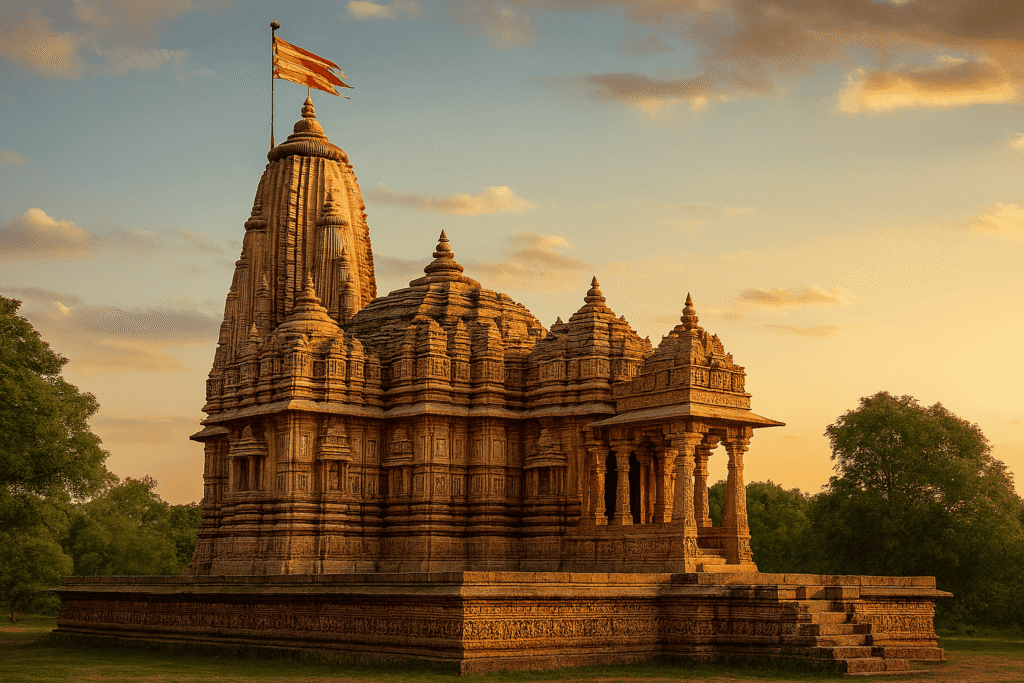
Nagara Style (North India): This style, dominant in Northern India, is primarily characterized by its towering, curvilinear spire (shikhara) that rises above the main sanctum (garbhagriha).[31, 32] Jain temples in Madhya Pradesh, Uttar Pradesh, and Rajasthan frequently employ this style. The celebrated Jain temples at Khajuraho, for example, are exemplary of the Nagara tradition, sharing many structural and decorative features with their famous Hindu counterparts at the site, distinguished primarily by their serene iconographic program.[33, 34]
Dravida Style (South India): Prevalent in the southern states, the Dravida style is defined by a stepped, pyramidal tower (vimana) over the sanctum, often set within one or more concentric enclosed courtyards (prakaras), with monumental gateway towers (gopuras) marking the entrances.[35, 36] The 8th-century Trilokyanatha Temple at Kanchipuram in Tamil Nadu is a classic example, showcasing a three-tiered gopuram and other characteristic Dravidian features, demonstrating the deep integration of Jainism into the Southern architectural milieu.[37]
Vesara Style (Deccan): This hybrid style flourished in the Deccan region, particularly in modern-day Karnataka, under dynasties like the Western Chalukyas and the Hoysalas.[38, 39] It creatively fuses elements from both the northern Nagara style (in the shape of the superstructure) and the southern Dravida style (in its ground plan and ornamentation). Jain basadis (temples) from this period, such as the Brahma Jinalaya at Lakkundi, are important examples of this innovative synthesis.[40, 41]
Māru-Gurjara Style (Western India): Originating in Gujarat and Rajasthan around the 10th century, this regional style became exceptionally popular with Jain patrons and is arguably the most famous style associated with Jain architecture.[16] It is distinguished by its highly ornate exterior walls featuring a multitude of projections and recesses, extremely lavish interior carving (especially on pillars and ceilings), the use of distinctive “flying arches” (toranas) between pillars, and spectacular corbelled domes with intricate rosette pendants (padma-śila).[16, 26] The world-renowned temple complexes at Dilwara (Mount Abu) and Ranakpur are masterpieces of this style.[16, 42]
Section 3: A Pan-Indian Survey of Digambar Jain Heritage
The geographical spread of Digambar Jainism has produced a rich and diverse architectural heritage. From the rock-cut caves of the Deccan to the temple-cities of the north and west, each region has contributed a unique chapter to the story of Jain sacred space. This survey examines key sites across eight states, highlighting their historical context, architectural style, and philosophical significance.
Table 1: Key Digambar Jain Sites by State: A Comparative Overview
| Site Name | State | Approximate Period / Key Dynasty | Dominant Architectural Style | Primary Deity / Key Features | Philosophical Embodiment |
| Ellora Caves | Maharashtra | 9th-10th C. CE / Rashtrakuta | Rock-cut | Indra Sabha (Cave 32), Jagannatha Sabha (Cave 33) | Monastic austerity and the celestial court (samavasarana) in stone |
| Shravanabelagola | Karnataka | 10th C. CE (statue) / Ganga, Hoysala | Dravida, Vesara | 18m Gomateshwara monolith, Chandragiri basadis | Supreme embodiment of Kayotsarga (body-abandonment) and renunciation |
| Khajuraho | Madhya Pradesh | 10th-12th C. CE / Chandela | Nagara | Parshvanatha Temple, Shantinath Temple | Serene contemplation and dispassion within a grand royal architectural style |
| Mathura (Kankali Tila) | Uttar Pradesh | c. 2nd C. BCE – 12th C. CE / Kushan, Gupta | Sculptural finds (stupas, ayagapatas, idols) | Foundational site for Jain iconography; earliest Tirthankara images; Ayagapatas (votive slabs) | Codification of Tirthankara iconography; transition from symbolic to anthropomorphic worship |
| Deogarh | Uttar Pradesh | 8th-17th C. CE / Gurjara-Pratihara, Chandela | Nagara | 31 temples, extensive Tirthankara and Yakshi iconography | A historical archive of evolving iconography and devotional practice |
| Hastinapur | Uttar Pradesh | Ancient site; modern constructions | Eclectic, Representational | Bada Mandir (1801), Jambudweep, Teen Lok Rachna | Didactic, literal representation of Jain cosmology for modern pilgrims |
| Shri Mahaveerji | Rajasthan | c. 18th C. onwards | Māru-Gurjara / Rajput influence | Miraculous idol of Mahavira, 52-foot Manastambha | Devotional worship (bhakti) and community pilgrimage |
| Pawapuri | Bihar | Ancient site; later constructions | Nagara / Regional styles | Jal Mandir (Water Temple) marking nirvana site | Sanctity of place; commemoration of Mahavira’s final liberation |
| Shikharji | Jharkhand | Ancient site; structures from 18th C. onwards | Nagara / Regional styles | Mountain as temple; Tonks for 20 Tirthankaras | The ultimate Tirtha; geography as a monument to mass liberation (moksha) |
| Trilokyanatha Temple | Tamil Nadu | 8th C. CE / Pallava | Dravida | Three-shrined temple for Mahavira, Neminatha, Lokanathar | Integration of Jain ideals within the dominant Southern architectural idiom |
3.1. The Deccan Plateau: Maharashtra & Karnataka
The Deccan plateau, particularly the regions of Maharashtra and Karnataka, served as an early and enduring heartland for the Digambara sect.[5]
Maharashtra: The state is renowned for its magnificent rock-cut architecture. The five Digambara Jain caves at Ellora (Caves 30-34), excavated primarily under Rashtrakuta patronage in the 9th and 10th centuries, represent the zenith of this tradition.[5, 21, 23] Though smaller in scale than their Hindu counterparts at the site, they are celebrated for their exceptionally fine and delicate carvings.[22, 23] Key monuments include the Chhota Kailasa (Cave 30), a monolithic replica of the great Kailasa temple, and the two-storied halls of the Indra Sabha (Cave 32) and Jagannatha Sabha (Cave 33).[21] Their iconographic program, featuring serene images of Mahavira and Parshvanatha amidst celestial figures, is designed to evoke both the austerity of the Jain path and the divine atmosphere of the samavasarana.[29, 30] Other important sites include the ancient cave temples on the Nemgiri and Chandragiri hills in Parbhani, developed during the reign of the Rashtrakuta emperor Amoghavarsha, and the temple at Ter (Osmanabad), a historic commercial hub with a revered black stone idol of Lord Mahavira dating to the 12th century.[43, 44]
Karnataka: This region is arguably the most significant historical center for the Digambara community.[5, 41] The paramount pilgrimage site is Shravanabelagola in Hassan district, a sacred center for over two millennia.[45, 46] It is distinguished by two hills. Vindhyagiri is dominated by the awe-inspiring 18-meter (58.8 ft) monolithic statue of Gomateshwara (Bahubali), consecrated in 981 CE by the Ganga minister Chavundaraya.[45] This statue is the world’s ultimate expression of Kayotsarga and Veetaragata, depicting Bahubali’s profound meditation and renunciation of his kingdom.[45] The opposite hill, Chandragiri, is a dense complex of 14 older basadis (temples), primarily in the Dravidian style, dating from the 8th century onwards and enclosed within a fort-like wall.[47] Notable among these are the Chamundaraya Basadi and the Parshvanatha Basadi, which together provide a rich timeline of architectural development.[48, 49] Another key site is Lakkundi in Gadag district, an important center under the Western Chalukyas, which features the Brahma Jinalaya, a prime example of the hybrid Vesara style.[40, 41]
3.2. Central & Northern Heartland: Madhya Pradesh & Uttar Pradesh
This region is rich in sites connected to the lives of Tirthankaras and the patronage of powerful medieval dynasties.
Madhya Pradesh: The eastern group of temples at Khajuraho, built by the Chandela kings (10th-12th centuries), includes some of the most magnificent Jain temples in India.[33, 34] Constructed in the Nagara style, they share an architectural affinity with the famous Hindu temples at the site but are distinguished by a serene and less overtly erotic sculptural program.[34, 50] The Parshvanath, Adinath, and Shantinath temples are living places of worship, housing impressive idols and showcasing the pinnacle of Chandela artistry.[33] Other sites like Kundalpur and Sagar feature large-scale medieval and modern temples that blend traditional architecture with contemporary scale, housing colossal idols within intricately carved marble halls.[51, 52]
Uttar Pradesh: As the location of many Kalyanaks (auspicious life events) of the Tirthankaras, this state holds immense sanctity. Its historical importance begins with Mathura, which was one of the most significant early centers for Jain art and sculpture, flourishing from as early as the 2nd century BCE through the Kushan and Gupta periods. The archaeological site of Kankali Tila in Mathura has yielded a vast treasure of Jain artifacts, including the remains of a stupa, numerous votive slabs known as ayagapatas, and some of the earliest known Tirthankara images.[8] These findings are crucial for understanding the evolution of Jain iconography, marking the transition from symbolic worship (stupas, emblems) to the anthropomorphic depiction of Jinas. The discovery of nude Tirthankara statues dating to the 2nd century CE and after provides some of the earliest and most definitive evidence for the iconographic traditions of the Digambara sect.[6] While structural temples from this period have not survived, the sculptural art of Mathura established the foundational visual language for Tirthankara imagery that would influence Jain temples for centuries to come. A more extensive, later complex is found at Deogarh in Lalitpur district, a vast archaeological site containing a complex of 31 Jain temples constructed over a millennium, from the 8th to the 17th century.[15, 53] Clustered within a hill fort, Deogarh is a veritable museum of Jain iconography, with over 2,000 sculptures that document the evolution of Tirthankara, Yaksha, and Yakshi imagery.[54, 55] The 9th-century Shantinath temple (Temple No. 12) is a key monument of the early Nagara style.[56] Hastinapur, the birthplace of three Tirthankaras, is another major center.[15] While the oldest temple, the Digamber Jain Bada Mandir, dates to 1801, the modern 40-acre complex is famous for its large-scale, explicit representations of Jain cosmology, including the Jambudweep and Teen Lok Rachna models.[15] Ancient holy sites like Ayodhya and Kaushambi are also associated with the births of several Tirthankaras, with modern temples now marking these sacred grounds.[9, 57]
3.3. The Western Strongholds: Rajasthan
Jainism in Rajasthan flourished under the patronage of a prosperous merchant class, resulting in some of the most ornate temples in India, predominantly in the Māru-Gurjara style.[16, 28] Digambara centers are particularly prominent in the northern and eastern parts of the state.[58] The Shri Mahaveerji temple in Karauli is a major Digambar pilgrimage site, established over 200 years ago around a miraculously discovered idol of Mahavira.[28] Its imposing architecture features high pinnacles and a towering 52-foot Manastambha (column of honor).[28] While the famous temples of Ranakpur are largely associated with the Śvetāmbara sect, their architectural splendor, especially the Chaumukha temple with its 1,444 uniquely carved pillars, represents the zenith of 15th-century Māru-Gurjara design and influenced temple construction across sects.[42, 59] Other Digambar sites like Andeshwar Parshwanathji in Banswara and the Digambar Jain Mandir in Jaipur exhibit a beautiful synthesis of Māru-Gurjara and regional Rajput architectural elements.[27, 60]
3.4. The Eastern Sanctuaries: Bihar & Jharkhand
This region is the cradle of Jainism, sanctified by the life and liberation of Lord Mahavira and numerous other Tirthankaras.
Bihar: This is the land of Mahavira’s birth (janma) and final liberation (nirvana). Pawapuri is revered as the site where Mahavira was cremated. The iconic Jal Mandir, a pristine white marble temple situated in the middle of a lotus pond, marks this sacred spot and is a place of immense sanctity for all Jains.[61, 62] Rajgir, where Mahavira spent fourteen rainy seasons, is another major Siddha Kshetra (place of liberation), its surrounding hills dotted with ancient and modern temples of both Digambar and Śvetāmbara sects.[61, 63] Sites like Kundalpur and Vasokund are traditionally identified as the birthplace of Mahavira.[61]
Jharkhand: The state is home to Shikharji, located on Parasnath Hill, which is considered the most important Jain Tirtha in the world—the “King of Teerths”.[64, 65] It is believed that twenty of the twenty-four Tirthankaras, along with countless other monks, attained moksha on this mountain.[64, 66] The entire hill is a vast sacred complex, with a 27-kilometer pilgrimage path (parikrama) leading devotees to the various tonks—small shrines marking the precise spots of liberation for each Tirthankara.[64] The temples at the base in Madhuban and on the hill itself have been built and rebuilt over centuries, with some existing structures dating to the 18th century, making the landscape a layered monument to millennia of devotion.[64, 66, 67]
3.5. The Ancient Southern Frontier: Tamil Nadu
Jainism has a long and venerable history in Tamil Nadu, where its temples were constructed in the prevailing Dravidian architectural style.[35, 37] Kanchipuram, a great center of learning, was also known as Jaina Kanchi. It is home to the Trilokyanatha Temple, an 8th-century stone temple built during the Pallava dynasty.[37] Dedicated to Mahavira and other Tirthankaras, it is a significant example of Dravidian architecture applied to a Jain context, featuring a three-tiered gopuram, circular sanctums, and rare, extensive ceiling paintings. The integration of Hindu deities as guardian figures (Ksetrapalas) also points to a fascinating history of religious syncretism.[37] Karanthai in Thiruvannamalai district is another ancient Digambar center with a history tracing back to the 8th century, with temples dedicated to Kunthunath and Parshwanath that exhibit classic Dravidian features like tiered superstructures and high compound walls.[68] Other ancient Digambar sites at Arpakkam and Thirunarunkondai (Shri Appandainathar Temple), with their rock-cut sculptures and rich collections of bronze idols, further attest to the deep and continuous presence of the Digambara tradition in the Tamil country.[69, 70]
Section 4: The Hoysala Connection – A Case Study in Patronage and Style
The Hoysala period in Karnataka (11th-14th centuries CE) offers a compelling case study of how a single, highly distinct architectural style was employed to serve the spiritual needs of different religious communities, including Hindus and Jains. This comparative analysis reveals the interplay between royal identity, artistic tradition, and religious ideology.
4.1. The Hoysala Architectural Idiom
Hoysala architecture represents a unique and highly sophisticated branch of the broader Karnata Dravida tradition.[71] Its artists developed a signature style that is immediately recognizable and celebrated for its intricate detail and sculptural quality. The defining features include:
Stellate Plans: The ground plan of the main shrine is often a complex star shape (stellate), which creates a dynamic interplay of light and shadow across the exterior walls through a series of projections and recesses.[72]
Soapstone Medium: The primary building material was chloritic schist, or soapstone. This relatively soft stone allowed artisans to achieve an extraordinary level of detail, carving it with the precision of ivory or sandalwood workers, resulting in a jewel-like finish.[72, 73]
Lathe-Turned Pillars: The interior halls are famous for their distinctive pillars, which are so perfectly rounded and polished that they appear to have been turned on a lathe. These pillars often feature intricate carvings and bell-shaped sections.[71]
Elaborate Sculptural Friezes: The exterior walls are covered with horizontal bands of exquisitely carved friezes, depicting processions of elephants, cavalry, swans, and mythological creatures, as well as extensive narrative panels from Hindu epics. This profusion of carving has been described as an “amazing display of sculptural exuberance”.[72, 74]
The development of this distinct style was a conscious act of cultural and political expression. By creating a unique architectural identity, the Hoysala dynasty distinguished itself from its predecessors, the Western Chalukyas, and its powerful contemporaries, the Cholas. Patronizing temples in this signature style was a method of projecting royal power, wealth, and cultural sophistication across the landscape, effectively making the style itself a symbol of the dynasty.[72]
4.2. Comparative Analysis: Jain Basadis vs. Hindu Temples
Hoysala rulers and ministers patronized the construction of temples dedicated to Shiva, Vishnu, and the Jain Tirthankaras, often utilizing the same architectural grammar for all.[71, 75] A Jain basadi at Halebidu, for instance, shares the same fundamental Hoysala features—stellate plan, lathe-turned pillars, and decorative friezes—as the nearby Hindu Hoysaleswara Temple.[71, 74] This demonstrates that the “style” was a product of established craft traditions possessed by artisan guilds, who applied their repertoire of techniques to projects regardless of the patron’s specific faith. The patron dictated the religious content, but the artistic execution remained within the domain of the craft lineage.
The crucial difference lies not in the architectural form but in the iconographic program and the spiritual intent it conveys. Where a Hindu temple would be adorned with dynamic, narrative panels depicting the exploits of Vishnu or Shiva, the Jain basadis feature serene, meditative images of the 24 Tirthankaras, such as Parshvanatha, Shantinatha, and Adinatha, along with their attendant guardian spirits (Yakshas and Yakshis).[71, 74]
This iconographic divergence reflects a fundamental difference in spiritual purpose. The active, narrative-rich sculptures of Hoysala Hindu temples are designed to facilitate bhakti—an emotional, devotional relationship with a personal, active deity. In contrast, the calm, static, and inward-looking Tirthankara images in the Jain basadis are not gods who intervene in the world but are objects of veneration. They serve as inspiration for meditation on the path of renunciation and the attainment of Veetaragata. The shared architectural vessel carries profoundly different spiritual contents.
4.3. The Influence of Royal Patronage and Religious Shifts
The architectural landscape of the Hoysala kingdom is a direct reflection of the complex and shifting religious affiliations of its rulers. The early Hoysala kings were patrons of Jainism.[74] King Vishnuvardhana, in his early reign as Bitti Deva, supported Jain institutions and made grants for the construction of basadis at important centers like Shravanabelagola and Kambadahalli.[74]
A pivotal moment in the dynasty’s history was Vishnuvardhana’s conversion to Vaishnavism, reportedly under the influence of the philosopher Ramanujacharya.[73, 74] This shift in royal allegiance led to a surge in the construction of major Vaishnava temples, most notably the magnificent Chennakesava Temple at Belur.[74, 75]
However, this conversion did not lead to the persecution or eradication of Jainism. The tradition of religious pluralism continued, as evidenced by the fact that Vishnuvardhana’s own queen, Shantala Devi, remained a devout Jain and patron of the faith.[74] Later Hoysala rulers, such as Narasimha III, also continued to support Jainism.[74] This complex dynamic of a primary royal faith coexisting with continued patronage for other traditions is materialized in stone. The presence of grand Hindu and Jain temples built concurrently in the same royal style, sometimes in the same capital city of Halebidu, serves as a physical testament to a society where different religious communities coexisted under a single political authority.[71, 74] While Hoysala rulers like Veera Ballala II did expand their territory into Tamil Nadu, the available research provides no direct evidence of a corresponding Hoysala architectural influence on the Jain temples within that region; the style’s impact remained largely concentrated in Karnataka.[73, 76]
Section 5: New Vistas – Recent Archaeological Findings and Evolving Traditions
The study of Jain architectural history is not a closed book but a field of continuous discovery. Recent archaeological findings are reshaping our understanding of Jainism’s historical footprint, while the living tradition continues to evolve, adapting ancient architectural forms to contemporary contexts.
5.1. Discoveries in the Deccan: Rewriting the Map
A significant discovery in June 2023 in Telangana has provided new evidence of a strong Jain presence in the Deccan. In Enikepalli village, Rangareddy district, two pillars bearing sculptures of four Tirthankaras—Adinatha, Neminatha, Parshvanatha, and Vardhamana Mahavira—were found repurposed as part of a village tank sluice.[77] Archaeologists estimate the sculptures to be approximately 1,000 years old, dating to the period of the Rashtrakutas and Vemulawada Chalukyas (9th-10th centuries CE).[77]
The pillars, one of granite and the other of black basalt, also bear inscriptions in a Telugu-Kannada script. It is believed they were originally part of a Jain basadi (monastery) near Chilukuru, a known Jain center during that era.[77] The historical implications of this find are profound. It provides concrete evidence for a prominent Jain community in a region where its history had been “neglected and forgotten,” forcing a re-evaluation of the extent of Jain influence under the Rashtrakutas and Chalukyas.[77, 78] The discovery also tells a story of the lifecycle of sacred objects: from revered icons in a living temple, to ruins, to secular repurposing in a water management structure, and finally to rediscovery as objects of historical and archaeological significance. This cycle offers a powerful narrative about the changing fortunes of religious traditions and the way history is physically embedded and recycled within the landscape.
5.2. Re-examining the East: The Heritage of Odisha
While the Udayagiri and Khandagiri caves (c. 1st century BCE) near Bhubaneswar are well-known monuments from the time of Emperor Kharavela, recent archaeological attention has shed more light on the continuity of Jainism in Odisha in later periods.[79, 80] Discoveries of Jaina Tirthankara and Sasanadevi (attendant goddess) sculptures at sites like Podasingidi in Keonjhar district and Charampa in Bhadrak district are crucial for understanding the early medieval period.[81]
Analysis of these sculptures, some of which are assigned to circa 750 CE, reveals the evolution of a regional Odishan artistic style applied to Jain iconography.[79] For example, a peculiar feature of the images from Charampa is the presence of numerous cut marks on their bodies, a stylistic deviation not seen elsewhere.[81] These findings challenge older narratives that may have over-emphasized the Brahmanical or Buddhist character of medieval Odisha, painting a more complex and accurate picture of a multi-religious landscape where Jain communities continued to thrive and produce significant works of art long after the era of Kharavela.[79, 82]
5.3. The Living Heritage: Modern Architectural Trends
The tradition of Jain temple construction is vibrant and continues to evolve, serving as a vital mechanism for preserving dharmic values and reinforcing community identity in the modern world.[27] A prominent trend in contemporary Digambar Jain temple architecture is the revival and widespread adoption of the historic Māru-Gurjara style.
Originally a regional style of western India, its key features—the use of white marble, ornate pillars, intricately carved domed ceilings with lotus pendants, and multiple shikharas—have been embraced so widely that it is now considered an “International Jaina Style”.[16, 26] Modern temples, whether in India or in the global diaspora, frequently employ this architectural language. 20th-century temples like the Pāvāpurī temple at Krishnaganj, Rajasthan, are clear examples of a conscious refashioning of this historic style.[26]
This is not merely an aesthetic choice; it is a deliberate act of creating a recognizable, unified architectural identity for a geographically dispersed community. In a globalized world, a shared and distinct architectural style serves as a powerful symbol of heritage and collective identity, instantly marking a building as a Jain sacred space, whether it is located in Rajasthan or New Jersey. These modern temples often synthesize various traditional elements while leveraging contemporary construction techniques to achieve unprecedented scale, reflecting a community that is both deeply rooted in its history and confidently asserting its identity in the modern world.[51, 83]
Conclusion: The Enduring Form of Dispassion
This report has traced the intricate relationship between the Digambar Jain philosophy of Veetaragata and its architectural expression across India. The ideal of the dispassionate, world-renouncing Tirthankara is enshrined at the heart of every temple, from the austere, rock-cut shelters of early monks to the opulent marble complexes of medieval merchants. The architectural journey reveals not a static tradition, but a dynamic and adaptive one, capable of absorbing regional artistic languages—Nagara, Dravida, Vesara—while preserving a core cosmological and iconographic identity. The central paradox of the tradition—the reconciliation of extreme austerity (Aparigraha) with lavish ornamentation—finds its resolution in the temple’s function as a bridge between the ascetic ideal and the devotional world of the laity. The temple space becomes a representation of the celestial realms, an offering of material wealth for spiritual merit, and a didactic map of the soul’s journey. From the historical layers of Deogarh and Shravanabelagola to the ongoing discoveries in Telangana and the global revival of the Māru-Gurjara style, the Digambar Jain temple stands as a testament to a faith that has, for over two millennia, consistently translated the profound stillness of inner dispassion into enduring, and often breathtaking, forms of stone and space.